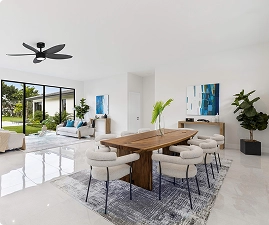





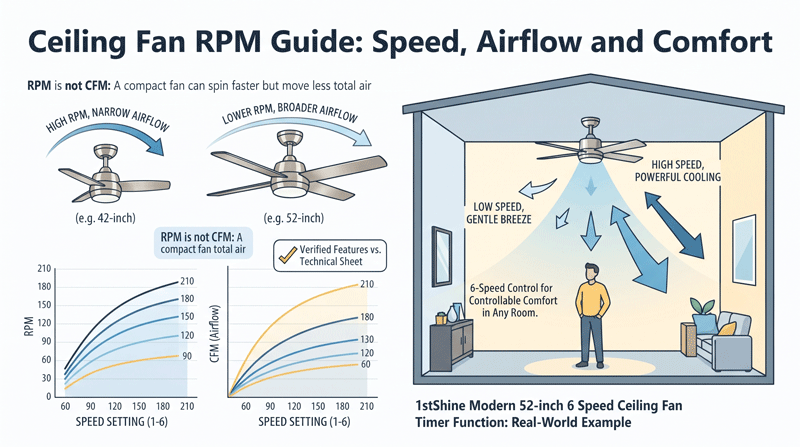
Ceiling fan RPM tells you how quickly the blades rotate, but it does not tell you everything about the breeze you will feel. A compact fan can spin quickly while a larger fan turns more slowly and moves air across a broader area. Even two fans with the same diameter and rotational speed can produce different airflow because their blades and motors work differently. For a buyer, the useful question is therefore how speed contributes to comfortable, controllable air movement in the intended room.
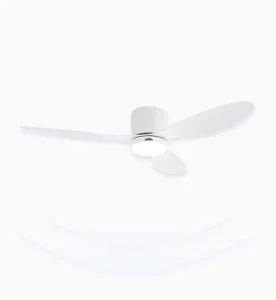
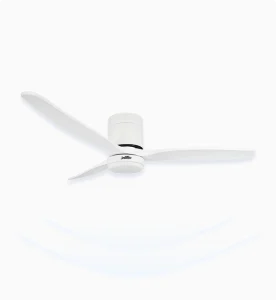
This guide explains RPM (Revolutions Per Minute) in practical terms and shows how to evaluate a fan when a product page lists several speed settings without publishing their exact rotational rates. It uses the 1stShine Modern 52-inch 6 Speed Ceiling Fan Timer Function as a product example. The discussion separates verified features from information that requires a model-specific technical sheet, so you can compare realistic everyday use rather than assume a larger number always means better performance.
What Ceiling Fan RPM Actually Measures
RPM counts the number of complete rotations a fan makes in one minute. If a blade completes 180 rotations during a minute of steady operation, its rotational speed is 180 RPM. That number describes motion around the motor axis. It does not directly describe the volume of air delivered, the velocity at your chair, the electrical input, or the sound level beside your bed. Those are separate quantities that need separate measurements.
Rotational speed is different from a speed setting
A remote marked with six speed levels provides six selectable operating commands. The numbers on the buttons are positions in that product’s control system, rather than published RPM measurements. Level three on one fan is not necessarily the same rotational speed as level three on another. Equally, six levels do not prove that the distance between each pair of settings is identical. Manufacturers may space those steps to suit the motor, blade load and intended comfort range.
For a useful comparison, ask whether the technical sheet reports blade RPM at each setting and identifies the tested size and electrical version. A statement such as six speeds answers how many choices are available. A table of measured rotational rates answers how fast each choice turns the blades. Keeping those two answers separate prevents a common purchasing error: treating a control feature as a performance result.
Use consistent terms when comparing specifications
The ceiling fan glossary is a useful starting point for separating rotational speed, airflow and electrical terminology. Write down the quantity, unit and operating setting beside every number you collect. RPM belongs beside blade rotation; CFM belongs beside volumetric airflow; watts belong beside electrical input. A numerical comparison without these labels can look precise while comparing fundamentally different things.
A good specification also distinguishes steady running from startup. Many electronically controlled fans accelerate gradually before settling at the requested level. Brief movement during that transition should not be mistaken for the rated operating speed. When a supplier provides a performance table, request the stabilized results and the test conditions rather than a momentary observation from a demonstration video.
Why Ceiling Fan RPM Cannot Replace Airflow Data
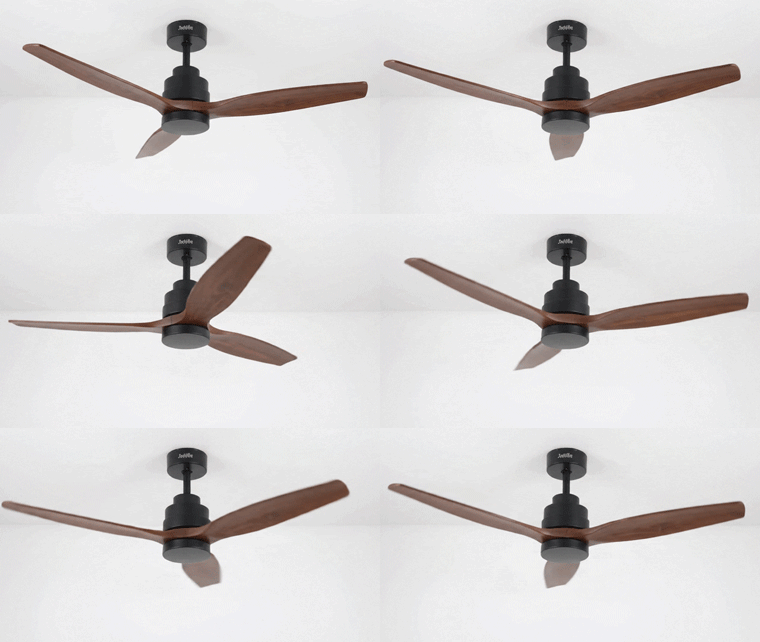
Airflow is produced by a complete rotating system. The blade span, blade shape, pitch, motor capability and surrounding installation all influence the result. Increasing rotational speed often increases air movement for the same assembled fan, but that relationship cannot be transferred unchanged between unrelated designs. A high maximum RPM therefore provides an incomplete basis for ranking products from different ranges.
Diameter changes what a given RPM means
Consider two hypothetical fans, one 42 inches across and the other 52 inches across, both rotating at 180 RPM. A point near the tip of the larger blade travels around a longer circle during each revolution. Its linear travel per minute is greater even though the revolution count is identical. This geometric example helps explain why a single rotational speed can represent different blade motion on different diameters.
Tip speed can be estimated as pi multiplied by diameter multiplied by RPM, with compatible units. Using metres and revolutions per minute produces metres per minute. For illustration only, a 1.32-metre diameter at 180 RPM gives approximately 746 metres per minute, or 12.4 metres per second, at the nominal tip radius. This is blade motion, not a measured wind speed beneath a fan, and these hypothetical values are not specifications for the featured product.
Do not turn tip speed into a room airflow claim
Air does not follow every point on a blade at the same speed. The surrounding flow is three dimensional, changes with distance and interacts with the room. A calculated blade-tip speed cannot establish CFM, coverage area or comfort at a sofa. Use the calculation to understand geometry, then return to independently reported airflow results and a suitable installation when judging performance.
Blade geometry and motor capacity matter together
ENERGY STAR performance components guidance explains that fan performance depends on the combination of components, including blade design, pitch, length and motor speed. This supports a system-level comparison rather than choosing the highest figure in one column. A sharply pitched blade is not automatically superior if the motor and complete assembly do not deliver the required operating result.
For buyers, this means comparing airflow at useful settings as well as at maximum output. A fan that provides a comfortable moderate breeze at a setting you enjoy may be a better daily fit than one with an impressive maximum that you rarely select. If broad air movement is the priority, explore the large and high CFM ceiling fan category and request comparable airflow data instead of using RPM as a substitute.
Reading Ceiling Fan RPM Across Six Speed Levels
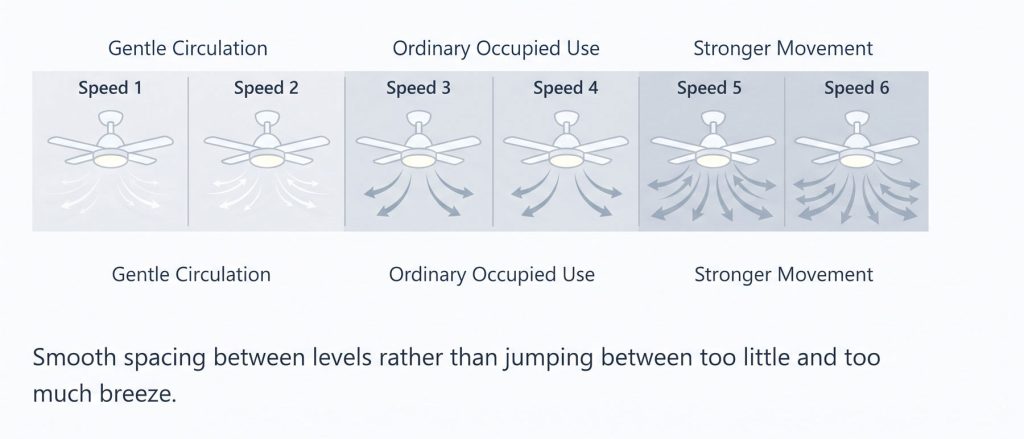
Multiple speed settings can make a fan easier to adapt to changing activity. The practical value comes from the range and spacing of the usable settings. A low setting should be evaluated for gentle circulation, a middle setting for ordinary occupied use, and a high setting for the occasions when stronger movement is welcome. The ideal sequence is one you can adjust without repeatedly jumping between too little and too much breeze.
Build a comparison table around evidence
Use the following checklist when requesting information from a supplier. It is a purchasing framework rather than a measured performance table for any specific model. Blank or unpublished information should remain clearly identified until the supplier provides the relevant document. Filling gaps with values copied from another diameter or a similar-looking fan creates a misleading comparison.
| Specification | What it answers | What to request |
| Number of speed levels | How many operating choices exist | Control instructions for the exact model |
| Blade RPM at each level | How quickly the assembly rotates | Stabilized model-specific speed table |
| Airflow at each level | How much air the fan delivers | Test method and matching configuration |
| Input watts at each level | How much electrical power is used | Motor and lighting loads identified separately |
| Sound measurement | What measured acoustic result is reported | Distance, setting and measurement conditions |
| Minimum usable setting | Whether gentle circulation is available | A demonstration or documented low-speed result |
The table is most useful when every row refers to the same size, controller and market version. A common catalog page may contain several options, and a specification selected for one option may not apply to another. Before approving an order, include the full model reference and size on the quotation so the figures can be traced back to the product being supplied.
Avoid assuming evenly spaced RPM steps
Six levels could be arranged to provide especially fine control at the lower end, or they could prioritize broader separation near the top. Neither arrangement can be inferred from the number of buttons alone. If an adjacent setting feels noticeably stronger, that may reflect the intended control curve rather than a fault. Evaluate whether the available choices suit the room before deciding that a different step pattern is necessary.
For repeat purchases, ask the supplier to identify whether a replacement controller preserves the same speed behavior. The motor, receiver and control commands should remain a compatible set. A remote with the same number of buttons does not prove that it sends the same commands or creates the same operating sequence.
Ceiling Fan RPM in the Featured Six-Speed Model
The current product page for the Modern 52-inch six-speed model lists a DC motor, six wind speeds, a timer and reversible rotation. Its 52-inch specification shows a 132 cm diameter, flush mounting and integrated LED lighting. These features make it a useful example for examining selectable speed and everyday control in an indoor installation. They do not establish an exact RPM curve or a tested acoustic result.
What is verified and what still needs documentation
The model reference shown on the page is DCF-K52070L. The page does not provide a complete per-setting table of blade RPM, airflow, input power and measured sound under stated conditions. A buyer needing those figures should request the technical sheet for the selected version. The presence of six speeds should not be converted into invented values such as a particular minimum RPM, maximum CFM or guaranteed decibel level.
The page also offers another diameter option, so confirm the chosen size before using a dimension in a drawing or purchase order. A product family can share a design language and control features while differing in its physical or performance characteristics. Record the selected configuration explicitly, especially when several rooms require different sizes or finishes.
Match the product category to the decision
The smart and modern ceiling fan collection is relevant when the project needs contemporary styling and convenient control options. However, category language does not prove that every model supports an app, Wi-Fi, voice commands or a particular home automation system. Choose those functions only when they are documented for the exact item. The featured model’s listed six speeds and timer are useful on their own without adding unverified connectivity claims.
If lighting is central to the room plan, compare the ceiling fans with lights collection while keeping fan speed and lighting specifications in separate parts of your checklist. An integrated light can simplify the fixture arrangement, but it does not tell you how slowly the blades will turn. Likewise, a flexible motor control does not establish dimming compatibility, color adjustment or a replaceable light module.
Ask for a sample when the low setting matters most
For a bedroom, reading corner or quiet reception area, a sample can answer questions that a short feature list leaves open. Observe the lowest setting from the actual occupied position, then move through the intermediate levels. The purpose is to assess comfort and control spacing, not to claim laboratory data from a casual demonstration. Keep any formal performance requirements in the purchase specification until they are supported by documentation.
Choosing Ceiling Fan RPM for Everyday Comfort
There is no universal best ceiling fan RPM for every room. Comfort depends on the person, the activity, clothing, ambient conditions and where the air reaches the body. A setting that feels pleasant while cleaning may be distracting while reading. A useful fan provides enough adjustment to respond to those changes while remaining compatible with the physical space and its installation requirements.
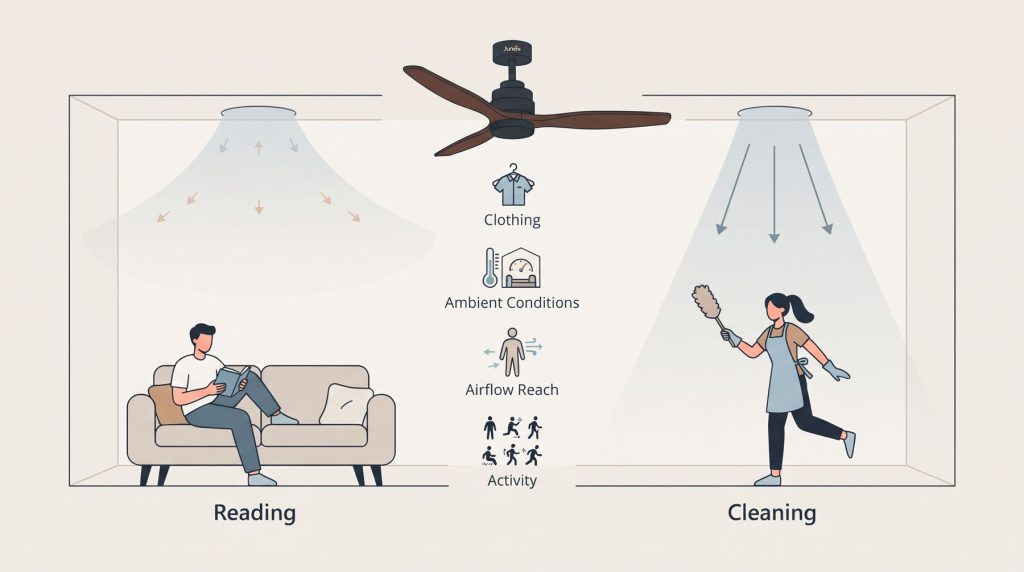
Start with the occupied position
For a living room, evaluate the breeze at the main seats rather than only directly beneath the motor. A central fan can create different sensations at the sofa, doorway and dining table. Room shape, furniture and open connections to adjacent spaces may affect distribution. If one area remains uncomfortable, increasing RPM may intensify the draft elsewhere without resolving the placement problem.
For a bedroom, consider the bed position, bedding movement and whether the chosen level remains comfortable after you have settled to sleep. Begin with the lowest useful setting and adjust only as needed. The bedroom and quiet ceiling fan range can help frame that search, but the word quiet should still be assessed against the specific model and the conditions of use.
Create a simple comfort record
During a sample evaluation, note the room, fan location, chosen setting and the position of the person assessing it. Record whether the breeze is insufficient, comfortable or intrusive. Repeat the comparison under reasonably similar conditions. This short record is more informative than remembering that one demonstration felt powerful, because it connects the control setting to the actual use case.
Keep subjective impressions separate from measurements. A statement such as comfortable at the desk on setting two is an observation for that room. It is not a universal RPM recommendation or a certified sound result. If several people use the space, obtain their feedback rather than treating one person’s preferred breeze as a fixed design standard.
Use the timer to support the chosen routine
A timer can stop the fan after a selected period, which is useful when the desired breeze is associated with a particular activity. Confirm the available timer intervals and whether the light is controlled independently before relying on a specific routine. The timer does not automatically improve the airflow at a speed level; it controls how long the selected operation continues.
ENERGY STAR installation and usage advice emphasizes that ceiling fans cool occupants rather than lower the temperature of an empty room. Turning the fan off when it is no longer needed avoids unnecessary operation. Treat a timer as a convenience that can help implement this habit, while recognizing that the best duration depends on occupancy rather than a universal overnight setting.
Ceiling Fan RPM, Power and Operating Cost
RPM and electrical input are related through the complete motor and blade system, but one cannot be calculated accurately from the other using a generic rule for all ceiling fans. A higher setting will often require more power on the same fan, yet the exact relationship must come from its data. Comparing operating cost therefore starts with measured or documented watts at the settings you expect to use.
Calculate cost from watts and hours
For a straightforward estimate, multiply electrical input in watts by operating hours, then divide by one thousand to obtain kilowatt-hours. Multiply that energy by the applicable electricity rate to estimate cost. Keep the rate, hours and power assumptions visible. This approach produces a transparent scenario that you can update when the actual product figures or tariff become available.
For example, a hypothetical 25-watt motor running for eight hours would use 0.2 kWh. At an illustrative rate of 0.20 per kWh, that would cost 0.04 in the same currency for that period. These numbers are an arithmetic example, not measured consumption for the featured six-speed model. Lighting, standby consumption and different operating levels need to be added when they are relevant to the comparison.
Compare the settings you will actually use
A maximum-speed wattage is helpful for identifying an upper operating point, but it may not describe a typical evening. If you expect several hours at a moderate breeze, request power and airflow data for that level. This reveals whether the fan delivers useful circulation under the intended routine rather than merely showing a favorable number at a setting that does not suit the occupants.
The energy efficient and budget ceiling fan range is a logical place to compare operating priorities, but a category is not a substitute for a model-specific efficiency result. Evaluate the complete purchase: supported performance, controls, installation compatibility, service access and actual energy use. A small difference in one catalog value may matter less than choosing a fan whose everyday settings are comfortable enough to use consistently.
Treat speed laws as limited engineering tools
Engineers sometimes use fan affinity relationships to estimate how changes in rotational speed affect flow and power under suitable similarity conditions. Those relationships are approximations with assumptions, not a universal calculator for unrelated domestic products. Electronic control losses, operating range, installation and different blade geometries can limit a simple scaling exercise. Do not use a guessed RPM value and a generic cubic relationship to advertise a precise energy saving.
If a supplier supplies a calculated estimate rather than a test result, ask for that distinction to remain visible. Calculations can support preliminary evaluation, but the final procurement decision should identify which values are tested, which are rated and which are illustrative. Clear labeling prevents an early planning assumption from becoming an unsupported customer promise later.
Ceiling Fan RPM and Noise During Daily Use
Faster blade movement can change the character of airflow sound, but RPM alone cannot predict the sound heard in a room. Motor behavior, control electronics, blade design, mounting and nearby surfaces can all contribute. A product described as quiet may still be audible in a silent room, and a pleasant broad airflow sound can be judged differently from a narrow hum or intermittent click.
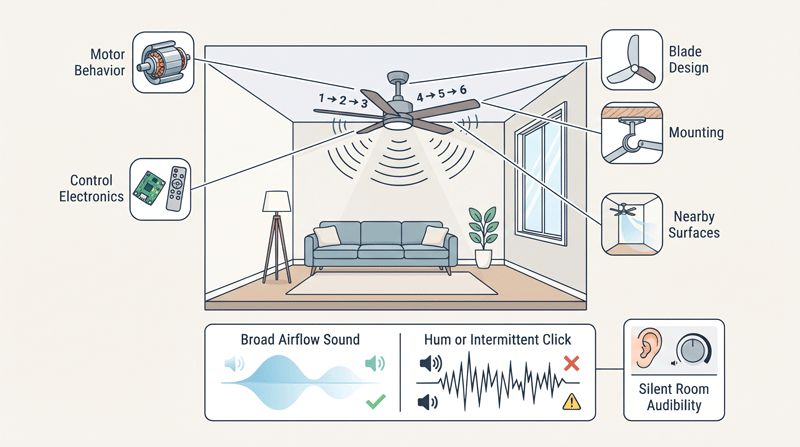
Separate air movement sound from unusual noises
Listen to the fan at the settings you intend to use, with the room in a normal operating condition. A broad rushing sound may rise as airflow increases. Repetitive clicking, scraping, new vibration or a strong electrical hum deserves a different response: identify the cause using the manufacturer’s support process rather than assuming it is an unavoidable result of higher RPM.
Do not use a smartphone recording alone to claim a precise decibel rating. Microphone processing, recording distance and background noise affect the result. A demonstration can help compare subjective impressions, but a procurement sound requirement needs a stated measurement method and comparable conditions. If sound is critical, request documented results at the relevant operating levels before finalizing the model.
Check control compatibility before blaming the motor
An unsuitable control can produce unwanted behavior even when the fan itself is correctly selected. ENERGY STAR control compatibility guidance warns against using a conventional lighting dimmer to operate a fan motor and recommends matching the control to the fan. A dimmer intended for a lamp does not become a suitable speed controller simply because it fits the wall plate.
For a DC fan with an electronic receiver, use the approved control arrangement for the exact motor system. Do not add a generic fan regulator, bypass the receiver or substitute an unrelated remote to obtain a lower RPM. Ask the supplier for compatible accessories and use a qualified installer where electrical work is required. The objective is reliable intended operation, not an experimental speed adjustment.
Document intermittent symptoms precisely
If a problem appears only on one setting, record that setting, whether the light was on, the approximate operating time and the type of sound. Note whether the issue begins at startup or after steady running. These details help support distinguish a control issue from a mounting or mechanical concern without requiring the owner to dismantle the assembly.
Installation Limits That Affect Usable Ceiling Fan RPM
The fan must suit the ceiling, support structure and required clearances before its speed range becomes useful. A well-chosen control curve cannot compensate for an unsuitable mounting arrangement. Check the manufacturer’s installation instructions and applicable local requirements for the selected model. If the room has a sloped ceiling, unusual ceiling height or obstructions, resolve those conditions before approving the fixture.
Confirm mounting and clearance dimensions separately
The featured product lists flush mounting, which describes how the assembly attaches near the ceiling. It does not automatically establish that every ceiling height is suitable. Overall fixture height and the distance from ceiling to blade plane are different dimensions. Where a needed blade-position measurement is not provided, request a drawing rather than inferring it from the overall height or a perspective photograph.
Measure the room and identify nearby walls, beams, cabinets, open doors and other potential obstructions. The installer should evaluate those conditions against the model instructions. Avoid a universal installation claim based only on a catalog word such as low profile. A correct dimensional check is more useful than trying to solve a clearance concern by promising to run the fan slowly.
Use the correct support and environment rating
The easy installation and low maintenance ceiling fan collection can help locate options with convenient ownership features, but every selected fan still requires suitable structural support and the specified installation method. Existing lighting hardware should not be assumed to support a rotating ceiling fan. Have the installer verify the appropriate fan-rated support arrangement for the location and jurisdiction.
Indoor suitability also differs from damp or wet location approval. A covered outdoor area can expose a fan to conditions that are absent in a bedroom. If the intended room is actually a porch or other exterior space, start with the all-weather outdoor ceiling fan collection and confirm the exact rating. A low RPM setting does not provide weather protection or change an indoor model’s approved environment.
Consider maintenance access before installation
A fan is easier to keep in good condition when its blades, light and accessible service points can be reached as instructed. Consider the practical maintenance arrangement during planning, particularly in furnished rooms or commercial settings. Do not assume that a flush mount eliminates all servicing needs. Access, approved cleaning methods and availability of matching replacement components remain relevant throughout ownership.
Dust accumulation or physical damage can change the behavior of a rotating assembly. Follow the manufacturer’s cleaning procedure, isolate power as directed and avoid placing cleaning tools against moving blades. If a blade or mounting component is damaged, stop using the fan and obtain model-specific advice. Continuing at a lower setting is not a repair or a substitute for correcting the problem.
Comparing Ceiling Fan RPM Before You Buy
A strong buying decision brings together comfort, documented performance and physical compatibility. RPM is useful within that process when its meaning and limitations stay clear. Instead of asking only which fan rotates fastest, ask which product provides the desired breeze across the settings you will use, with suitable dimensions and a supported control system. That question produces a more useful shortlist.
Request a complete, traceable quotation
Include the model, diameter, finish, electrical market version, control arrangement and installation type in the request. Ask for RPM, airflow and power at each available setting if those measurements matter to the project. Where data is unavailable, keep that gap explicit and decide whether a sample evaluation or another model is needed. A written unanswered question is better than an attractive assumption hidden in a comparison spreadsheet.
- Identify the exact room and occupied positions that need comfortable airflow.
- Confirm the selected diameter, mounting type and required clearances.
- Request speed, airflow and power figures for the same model configuration.
- Check the lowest useful setting as well as maximum output.
- Confirm approved controls, timer behavior and separate lighting operation.
- Record service access, replacement part support and relevant documentation.
When comparing the broader ceiling fan product collection, keep the evidence standard consistent. Do not compare a measured high-speed result on one model with an undefined marketing phrase on another. If two suppliers use different test methods or reporting conditions, ask them to explain the difference before treating the numbers as equivalent. Consistent questions make it easier to identify a product that fits the room rather than a listing that merely looks more detailed.
Decide when RPM is a requirement and when it is background information
For a household buyer, comfortable control steps and suitable airflow may matter more than knowing every rotational value. For a specification project, an exact operating range may be necessary for design coordination or acceptance testing. State that requirement at the beginning so the supplier can confirm whether the chosen model has the required documentation. Do not introduce a numerical acceptance limit after ordering from a feature-only page.
If a sample is approved, record what was actually evaluated: the configuration, controller, room context and selected settings. Keep subjective comfort approval separate from formal electrical, acoustic or airflow compliance. This creates a usable reference for later deliveries without claiming that a simple room demonstration replaces technical verification.
Conclusion: Choose Ceiling Fan RPM for Useful Comfort
Ceiling fan RPM is a clear measure of rotational speed, but a comfortable purchase requires more context. Diameter, blade geometry, airflow, electrical input, controls and installation all influence the experience. Compare the complete system and the settings you expect to use. A faster maximum is not automatically a better daily choice, and six selectable levels do not reveal six measured rotational rates.
The featured six-speed flush-mount model offers a practical starting point for discussing adjustable indoor circulation, a timer and reversible operation. Its product page supports those listed features, while exact per-speed performance remains something to request for the selected configuration. Keeping that boundary visible helps turn a broad product interest into a clear and verifiable purchasing decision.
Contact the 1stShine team with your room dimensions, ceiling details, preferred size and everyday comfort priorities. Ask for the matching technical sheet and approved control information for the model under consideration. With those details in place, you can choose a ceiling fan for the useful breeze it delivers rather than relying on RPM alone.