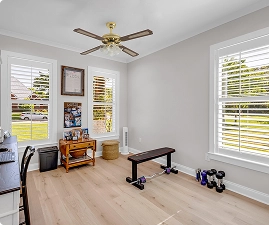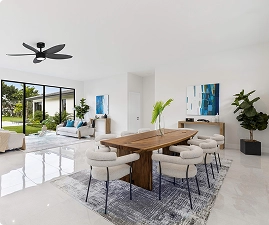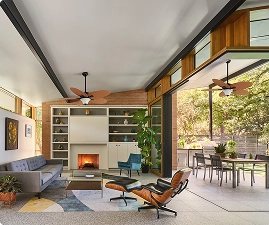





A ceiling fan downrod is a mounting component, not simply a decorative tube. Its length helps position the fan beneath the ceiling, while its connections form part of the assembly that supports a rotating appliance. Choosing one therefore requires more than matching a finish or buying the length suggested by a room photograph. The correct decision depends on the exact fan, its approved mounting system, the room geometry, and the documentation supplied for the installation.
This guide explains how to plan a downrod purchase, estimate the installed position, compare compatible options, and prepare a useful brief for the supplier and installer. It uses a current 1stShine downrod-mounted product as a reference while keeping model-specific facts separate from general planning examples. It does not assume that every rod fits every fan, or that changing rod length can correct an unsuitable installation location.
Start by recording the ceiling height and the proposed fan model. Then identify the manufacturer’s approved components and dimensioned drawing. That sequence lets you compare real options without turning a rough estimate into an instruction. A little work before ordering can prevent an attractive fan from arriving with the wrong mounting package, insufficient wire length, or a finished position that conflicts with furniture and normal movement through the room.
What a Ceiling Fan Downrod Does in the Mounting System
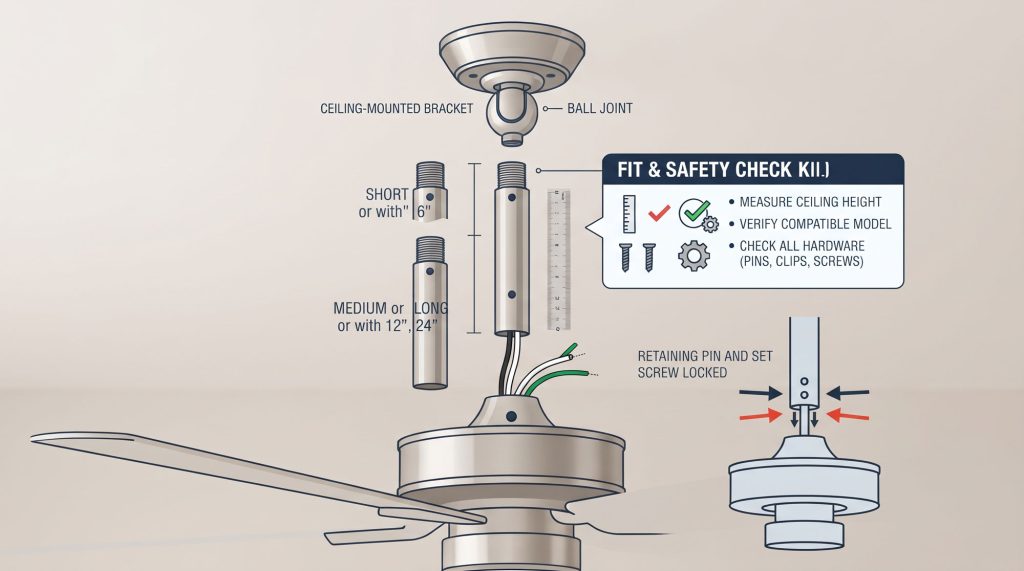
A downrod normally connects the upper mounting assembly to the fan motor assembly, carrying the fan beneath the ceiling while providing a route for its wiring. The exact connection design varies. Some systems use particular threaded joints, pins, retaining hardware, or a defined hanger arrangement. The approved components work together, so visual similarity is not sufficient evidence that an alternative rod belongs in the system.
The rod also changes the position of the blades and any light below them. That can influence room fit, occupied-zone air movement, and access for maintenance. It does not independently establish airflow or safety. The bracket, ceiling support, hanger, wiring, blade assembly, and clearances remain part of the same decision. A longer rod should therefore be treated as a configuration change to evaluate, rather than a universal improvement.
Understand which dimensions the supplier is describing
A listing may state rod length, total product height, ceiling-to-blade distance, or overall installed drop. These measurements are related but are not interchangeable. A rod may fit partly inside adjoining components, and the fan body adds dimensions of its own. Ask for a drawing identifying the start and end of each published dimension before calculating the finished blade plane or the lowest point of a light kit.
On a room plan, mark the ceiling connection, the blade plane, and the lowest component separately. This avoids the common mistake of checking clearance to the motor while forgetting the light beneath it. For an integrated fan light, the relevant dimensions should describe the selected configuration, including any shade, diffuser, or decorative element. A picture of a similar fan cannot resolve an ambiguous measurement.
Keep appearance and compatibility as separate checks
Matching a black rod to a black canopy solves only an appearance question. It says nothing about the joint geometry, material specification, approved length, or retaining parts. Obtain compatibility confirmation by exact fan and accessory identifiers. If a supplier offers a replacement, keep that confirmation with the order rather than relying on an informal statement that the parts are universal or should fit.
The broader ceiling fan collection is useful for comparing mounting styles before selecting an accessory. Once the model is chosen, narrow the discussion to its approved mounting package. This distinction saves time: product browsing can remain flexible, while the final component selection needs precise identifiers and documentation. It also makes future replacement simpler because the record explains which assembly was approved instead of merely describing its color and approximate size.
Measure the Room Before Selecting Downrod Length
Measure the actual installation location, not just a room’s nominal ceiling height. Floors, ceiling finishes, and decorative details can affect available space. In a renovation, confirm the finished dimensions after planned flooring or ceiling work. Record nearby beams, soffits, walls, doors, wardrobes, and elevated furniture. The fan’s operating envelope needs to be considered within the whole room, not as an isolated vertical line.
Also identify where people will sit, stand, sleep, and carry tall objects. A fan that appears centered architecturally may be poorly located for the occupied part of the room. If the intended position creates a conflict, review placement before using a different rod to compensate. A mounting accessory cannot remove a beam, create structural support, or make an undersized clearance acceptable.
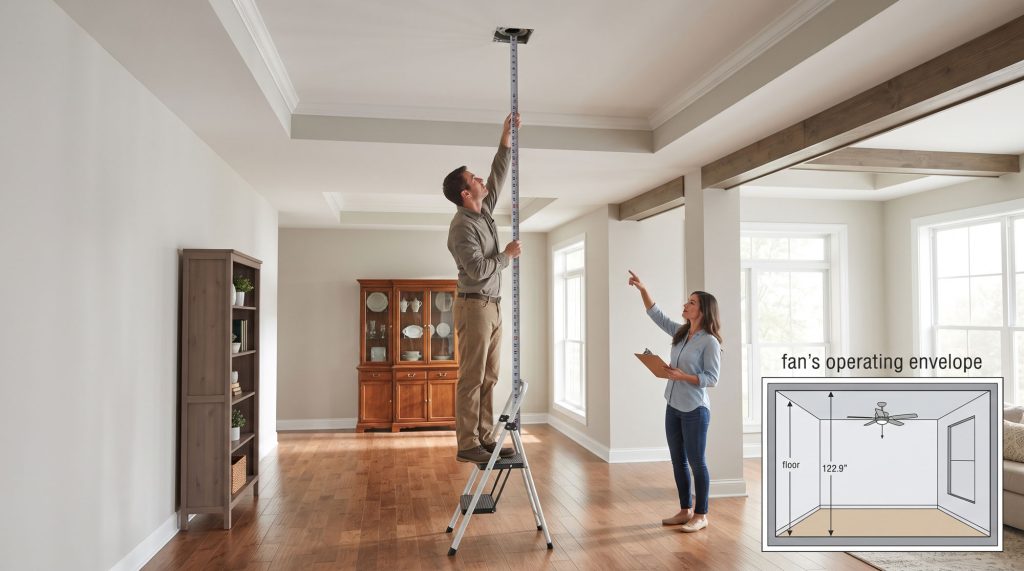
Build a short measurement record
Take a room photograph and add the measured ceiling height, proposed center point, nearby obstructions, and intended blade diameter. Include a simple plan view if furniture or circulation paths make the layout difficult to understand. For a multiroom order, give each room a unique identifier. This prevents a drawing for a tall living room from being accidentally applied to a lower bedroom with a similar decorative scheme.
Ask the installer to identify any measurement that cannot be confirmed from the floor. A ceiling cavity, existing support, or concealed wiring may require inspection. Keep these items marked as open rather than filling them with assumptions. A brief site check before purchase is usually more useful than debating rod length after a fan has arrived and the room’s actual limitations have become unavoidable.
Treat published clearance guidance as a starting point
ENERGY STAR ceiling fan basics provides general context for blade height, wall separation, and mounting styles. Its guidance is useful for preliminary planning, while the selected fan’s instructions and applicable local requirements determine the installation details. Do not assume that meeting one general number settles all clearances. Light fixtures, sloped ceilings, furniture, and other obstructions may introduce additional conditions for the exact room.
Once measurements are available, share the complete record with the supplier. A request stating only that the ceiling is high leaves too much unresolved. A dimensioned brief allows the supplier to recommend a compatible mounting option and explain the resulting installed position. It also gives the installer a clear basis for checking that the delivered configuration matches what was evaluated, rather than having to reconstruct the intended arrangement on site.
Estimate Downrod Length Using the Complete Fan Drawing
The basic planning relationship is straightforward: finished blade height equals ceiling height minus the complete distance from ceiling to blade plane. The difficult part is obtaining the correct complete distance. Rod length is only one element of that assembly. Canopy geometry, hanger position, motor housing, connection overlap, and blade mounting all contribute. Use the manufacturer’s drawing instead of adding visible dimensions guessed from a photograph.
For an illustrative room with a ceiling 3.0 meters above the finished floor, a proposed blade plane 2.5 meters above the floor leaves 0.5 meters for the full ceiling-to-blade assembly. That is not an instruction to order a 0.5-meter downrod. The approved fan assembly occupies part of the available distance. The supplier must confirm which rod configuration, if any, produces an appropriate installed position for that model.
Use the example to expose missing information
Write the calculation beside the drawing and label every value. If you know the ceiling height but not the ceiling-to-blade dimension, the calculation is incomplete. If you know the blade height but not the light’s lowest point, the room check is also incomplete. This approach makes uncertainty obvious and prevents a convenient arithmetic result from being treated as a complete installation specification.
Keep units consistent throughout the comparison. Convert inches, centimeters, and meters before using them in one calculation, and retain enough precision to avoid a misleading fit. Do not round a marginal clearance upward. When dimensions are close to a limit or the ceiling is irregular, have the installer verify the actual condition and ask the supplier for the approved configuration rather than relying on a rough shopping estimate.
Check more than one candidate configuration
If the fan supports several rod lengths, compare the finished blade plane and lowest point for each approved option. Evaluate those positions against furniture, circulation, visual scale, and service access. The best choice may be the configuration that meets the room’s needs with fewer complications, rather than the one that creates the longest possible drop. Keep the reasoning with the selection so a later substitution can be assessed consistently.
For a room with limited vertical space, compare the low-profile alternatives within the easy installation and low maintenance category before forcing a downrod-mounted design into the brief. Some models support only one mounting style; others have approved alternatives. Ask about the exact model rather than assuming a conversion is available. A purpose-designed alternative can be a better starting point when the available height and the preferred mounting system do not align.
Confirm Downrod Compatibility Before Buying an Extension
Accessory compatibility should be documented at model level. Ask for the approved rod part number, diameter, connection design, available lengths, finish, and required retaining hardware. Also ask whether the selected option changes installation steps or requires a different canopy, hanger, adapter, or wiring arrangement. These questions are not excessive detail: they define whether the accessory is actually part of the supported mounting system.
A rod described as standard may still be unsuitable for a particular fan. Shared dimensions do not establish equal load handling, joint engagement, or retention. Do not modify holes, cut threads, join unrelated rods, or substitute generic fasteners to make an accessory fit. If the supplied components do not assemble as instructed, stop and obtain clarification or the correct approved part rather than improvising a connection.
Request one configuration-specific package
For a new order, ask the supplier to quote the fan and the approved downrod together. The order should identify the complete mounting package and what arrives in each carton. This reduces the chance that the installer receives a fan with its default rod while a longer accessory is omitted or shipped separately without the retaining hardware needed to use it. Clear packaging information also helps the receiving team check the delivery accurately.
For a replacement, provide the full fan identifier, photographs of the existing assembly where safely obtainable, and the original documentation if available. Similar product names can conceal changes between revisions. Ask whether the replacement applies to the installed revision, not just the current version advertised online. If the model cannot be identified confidently, treat that uncertainty as a reason for further investigation rather than declaring the first visually similar rod compatible.
Confirm wiring provisions for the approved length
A longer mechanical assembly can require a different wiring provision. Ask whether the fan is supplied with adequate lead length or a manufacturer-approved extension arrangement for the selected rod. The electrician should follow the instructions and local requirements for connections and enclosure. Do not assume that a cable that can physically be pulled through the tube is suitable, or that an improvised connection can be hidden wherever space happens to be available.
Keep electrical planning separate from an assumption about motor type. A DC motor does not make the installation a low-voltage DIY accessory project, and a remote receiver still needs the correct supply and enclosure arrangement. For background terminology, use the site’s ceiling fan glossary where relevant, but obtain installation decisions from the model documentation and a qualified installer. General terminology explains the discussion; it does not authorize an unapproved modification.
Plan Downrod Mounting for Sloped or Vaulted Ceilings
On a sloped ceiling, a vertical downrod must work with an approved upper mounting arrangement and provide adequate clearance around the rotating blades. The slope can create a conflict on the uphill side even when the room’s central height looks generous. Record the ceiling angle, proposed position, blade diameter, and nearby beams before asking which mounting option is suitable. A room-height measurement by itself cannot describe that geometry.
Ask whether the selected fan permits the measured slope and whether it requires a particular adapter. A decorative canopy that appears to tilt does not prove the complete assembly is approved for the installation. Confirm the allowed angle and compatible hardware from the manufacturer. If the specified fan cannot accommodate the condition, compare another location or model instead of assembling an unsupported combination of adapters and rods.
Evaluate the rotating envelope in plan and section
A section sketch shows the slope and vertical position, while a plan view shows the blade circle relative to walls and obstructions. Use both when the roof structure is complex. Include beams, pendant lights, and any opening door that could intersect the operating area. The objective is to understand the full envelope of movement, not merely to verify that the motor can hang vertically without touching the ceiling.
A longer approved rod may move the blades away from the uphill ceiling, but that change also lowers the entire fan. Recheck the blade plane, lowest component, and room use after every change. This is why selecting length for a vaulted room is an iterative fit check. One dimension cannot be improved in isolation without reviewing what the resulting position means for the rest of the room.
Make the support location part of the design
The visually preferred point may not coincide with a suitable support location. Have the installer assess that condition early, especially where an existing light fitting is being replaced. Moving the fan, adding approved support, or revising the room layout may be necessary. Do not assume that a longer downrod changes the capacity of the structure above it or makes a decorative fitting’s original support adequate for a rotating fan.
For large rooms, explore the large and high CFM ceiling fan category while checking the mounting instructions for each candidate. Larger diameter can change the clearance problem on a slope, and heavier assemblies can change support planning. Choose a model because it meets the complete room brief, not because a dramatic vaulted ceiling makes the largest available fan look attractive in a catalog image.
Understand Downrod Materials, Finishes and Environment
A downrod’s finish should coordinate with the fan, but the installation environment deserves equal attention. Indoor rooms, covered outdoor areas, and locations exposed to weather are different conditions. Material appearance alone does not establish suitability. A finish described as durable or corrosion-resistant does not prove that the complete fan, receiver, connections, light, and mounting accessories are rated for the intended exposure.
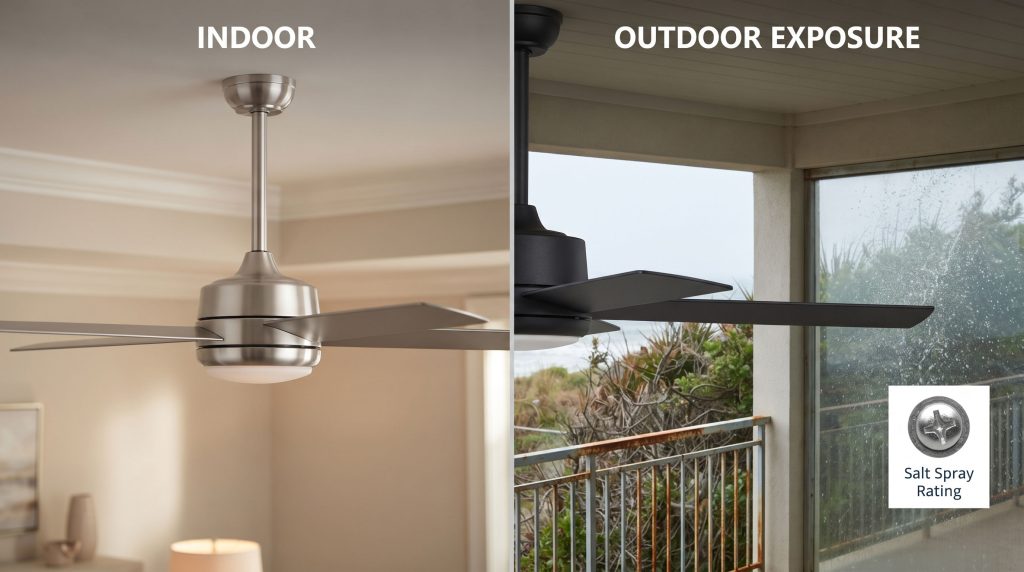
For an outdoor project, obtain the documented environmental suitability of the exact configuration, including the approved accessory. Do not transfer a rating from another fan in the same brand or assume that plastic blades make the whole assembly weatherproof. If the site experiences wind-driven rain, salt exposure, or persistent condensation, describe those conditions to the supplier rather than relying on a broad statement that the fan will be outside under a roof.
Match the accessory to the complete approved assembly
Ask whether every proposed rod length and finish is approved for the same environment as the selected fan. Confirm how the manufacturer expects exposed surfaces to be maintained and whether the warranty has location-related conditions. Keep those answers attached to the order. A replacement accessory should preserve the intended suitability of the original assembly, not merely reproduce its dimensions and color.
Avoid unsupported lifespan claims. Coating condition, cleaning practices, humidity, and exposure can vary widely between sites. Instead of promising a fixed number of years from a finish description, ask for maintenance instructions and inspect the delivered parts for damage. Packaging scratches or missing protective components should be resolved before installation so the owner is not left wondering whether a defect was present from the beginning.
Distinguish covered-patio styling from documented ratings
The all-weather outdoor ceiling fan collection is a useful place to start a search, while each product still requires a configuration-specific check. A photograph showing a covered patio is not an installation approval for every outdoor setting. Likewise, an indoor decorative model should not be moved outdoors simply because its mounting dimensions happen to fit the space. Suitability is a documented property of the assembly, not an inference from styling.
For interior projects, finish consistency may matter across several rooms. Ask whether the rod, canopy, and fan body come from a coordinated finish system and whether an extension could vary slightly in appearance. Review a sample where the decorative match is important. This is a practical appearance check that belongs alongside the technical compatibility check, with neither used as a substitute for the other.
Review a Real Downrod-Mounted Fan Configuration
The reference product is the 1stShine Vintage Antique Ceiling Fans for Patio and Study. Its current product page describes rattan-texture plastic blades, a frosted glass light fixture, a matte black motor base, a BLDC motor, three speed choices, and reversible operation. The displayed size table lists a 52-inch configuration with a 132 cm diameter, 48 cm overall height, integrated LED lighting, and downrod mounting.
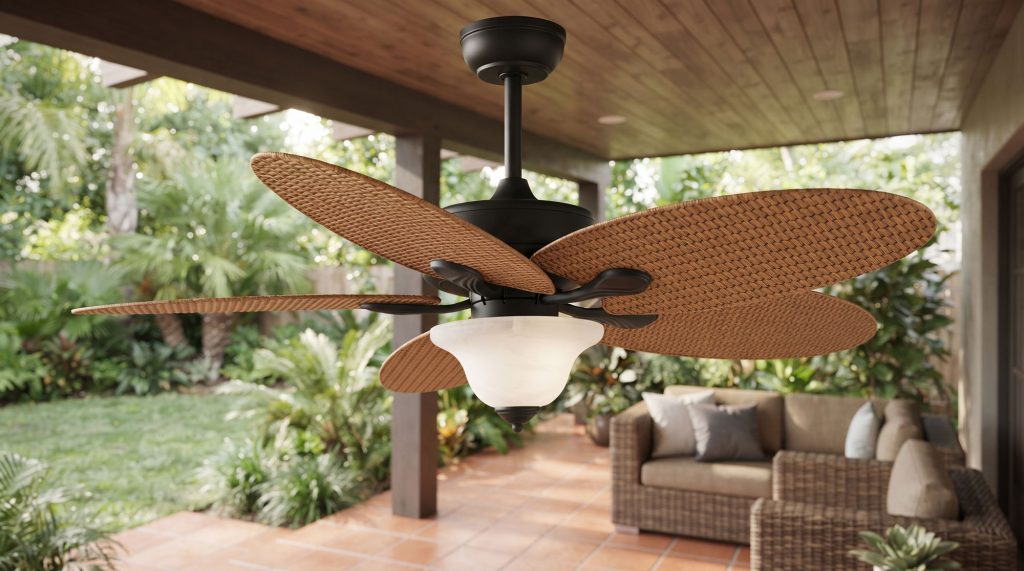
These published details identify a useful candidate for someone who wants a decorative downrod-mounted fan rather than a flush-mount appearance. They do not state that every aftermarket extension is compatible. The page’s ceiling-to-top-of-blade entry is not populated with a usable dimension, so that information needs confirmation before calculating a blade plane. Treat the 48 cm overall height as the labeled product dimension, not automatically as rod length or ceiling-to-blade distance.
Turn the product page into a supplier brief
Ask which rod is included in the displayed overall height and whether approved alternatives are offered. Request the full dimensioned drawing for the 52-inch configuration, including the lowest point of the light. Then ask whether changing the rod changes the published overall height by the full difference in rod lengths or whether connection geometry introduces another relationship. The supplier’s configuration drawing should resolve that question without guesswork.
The page presents the fan for study and covered-patio settings, but that wording should not be expanded into a wet-location claim. Ask for the documented rating applicable to the proposed room and market. If the project is indoors, focus the brief on room fit, support, control access, and the desired decorative proportion. If it is outdoors, add the exposure conditions and request explicit confirmation for the complete supplied package.
Separate known features from unconfirmed options
The presence of an integrated LED does not establish a particular dimming range, lumen output, or replacement procedure. The motor description does not establish a measured sound level in your room. Those details may matter to the wider purchase, but they should remain separate questions rather than assumed specifications. This keeps the downrod discussion anchored to verified dimensions and supported accessories instead of letting unrelated feature claims fill the gaps.
For a decorative comparison, review the vintage and industrial style collection and the luxury and premium series range. The aim is to identify which mounting configuration fits the intended interior, not to assume that more elaborate styling requires a longer rod. Compare the complete installed silhouette, blade clearance, light position, and access needs alongside finish. A well-proportioned result should also be a documented and serviceable installation.
Order the Downrod With a Clear Comparison Checklist
A practical order record connects the room measurements to the exact fan and accessory identifiers. It should show what was evaluated, which information remains open, and who will confirm the installation conditions. Keep the record short enough to use on site. A long folder of unrelated brochures is less helpful than one clear configuration summary with the relevant drawing and instructions attached.
Compare at least the included mounting option and any approved alternative being considered. If an extension is unavailable, record that fact and revisit the model choice instead of quietly substituting another brand’s accessory. A quotation is complete only when the physical items needed for the approved assembly are accounted for. That includes any adapter or special retaining component required by the selected configuration, not just the visible rod.
| Check | Information to record | Decision it supports |
| Room geometry | Finished ceiling height, slope, obstructions and furniture | Whether the proposed location fits |
| Complete fan drawing | Blade plane and lowest point for the selected variant | Installed clearance assessment |
| Approved downrod | Fan model, accessory identifier, length and finish | Compatibility and ordering |
| Electrical provision | Approved lead or extension arrangement and control package | Installer planning |
| Delivery contents | Bracket, hanger, retaining parts and required adapters | Receiving and installation readiness |
| Support and service | Installer review, access method and documentation location | Safe installation and future maintenance |
Keep receiving checks specific
When the order arrives, compare labels and contents with the approved configuration before scheduling final installation. Check the accessory identifier, finish, retaining parts, and documentation. Photograph damaged packaging and report missing or incorrect items promptly. Do not allow pressure to finish the room to turn an incomplete package into an improvised assembly. Resolving a discrepancy before the fan is overhead is usually easier than investigating it after installation.
For repeated room layouts, label cartons or installation records by room identifier. A project may need different rod configurations for visually similar spaces with different ceiling heights. Without a room schedule, installers can accidentally exchange packages and create a clearance problem that is not obvious from the model name. A simple room-to-configuration table prevents that confusion and helps the maintenance team identify the correct replacement later.
Document substitutions before accepting them
If the supplier proposes an alternative rod or fan revision, ask what changes in the drawing, instructions, accessory list, or installed position. Review those changes against the original room brief. Approval should identify the actual replacement configuration, not merely state that an equivalent item was supplied. Two assemblies may look similar while using different connection hardware or producing a different total drop beneath the ceiling.
A procurement decision also needs a clear route for support. Keep the supplier contact, order reference, approved drawing, and model instructions together. If a question arises during installation, this record lets the installer ask a precise question and identify the component concerned. It reduces dependence on memory and prevents a sequence of informal substitutions from erasing the connection between what was evaluated and what was ultimately installed.
Commission the Downrod Assembly and Plan Future Access
Installation should follow the supplied instructions and be carried out by a suitably qualified person for the work involved. A buying guide cannot establish the condition of concealed support or wiring. ENERGY STAR installation and usage guidance emphasizes the importance of appropriate support and manufacturer instructions; use that context to plan the work, while relying on the approved model documentation and local requirements for the actual installation.
After installation, check the delivered configuration against the room record. Confirm the visible accessory, finish, complete installed position, and operation of the fan and light. Ask the installer to address abnormal movement, noise, or control behavior according to the manufacturer’s process. Do not treat wobble as proof that any longer rod is inherently unsuitable, or assume that changing speed is an acceptable permanent response to an unresolved assembly problem.
Use a short acceptance record
- Identify the fan and approved downrod installed in each room.
- Confirm the finished blade plane and lowest component against the approved plan.
- Record the installer and the location of instructions and warranty information.
- Test normal controls and note any issue requiring supplier follow-up.
- Plan access for cleaning, inspection and future component replacement.
An acceptance record should describe observations rather than vague judgments. For example, note whether a canopy sits correctly, whether the normal control sequence works consistently, and whether an unusual sound occurs at a particular speed. Specific information helps the installer or supplier investigate. A broad statement that the fan is noisy or the rod looks wrong may be understandable, but it is less useful for identifying the part of the assembly that needs attention.
Keep maintenance realistic for the installed height
A high ceiling can make cleaning and repair access more expensive than anticipated. Decide how the fan will be reached without relying on furniture or improvised platforms. Keep the floor area needed for access in mind when planning large fixed furniture beneath the fan. The mounting configuration should work for the life of the installation, not only for the day when the room is empty and installers have unrestricted access.
Follow the manufacturer’s maintenance instructions instead of inventing a lubrication, tightening, or coating routine. If a part needs replacement, use the documented model and accessory identifiers to obtain the approved item. Keep a record of changes so future work starts from the actual installed configuration. That small amount of documentation protects the value of the original selection and makes later service more predictable for the owner.
Conclusion: Choose a Downrod as Part of the Whole Fan
The right ceiling fan downrod is the approved component that places the complete fan appropriately within the real room. Measure the space, understand the drawing, confirm compatibility, and review the installed blade plane and lowest component together. Do not confuse overall product height with rod length, or a matching finish with a supported mechanical connection. Clear information is more useful than a confident estimate based on an unrelated product.
The reference 52-inch vintage model illustrates why that approach matters. Its page confirms downrod mounting and a labeled overall height, while leaving important accessory and blade-position questions for the supplier to resolve. Those open questions do not make the product unsuitable; they identify the information needed before approving a configuration. A documented answer lets the buyer, supplier, and installer work from the same plan.
For a configuration-specific recommendation, contact the 1stShine team with your room measurements, ceiling slope, proposed fan location, selected model, and preferred finish. Request the approved downrod options, complete dimensions, and included mounting components before placing the order. A precise brief makes it easier to choose a fan that looks right, fits the room, and can be installed and maintained using the intended system.