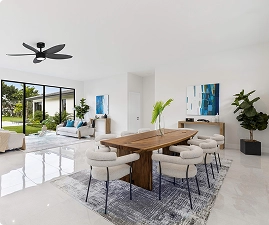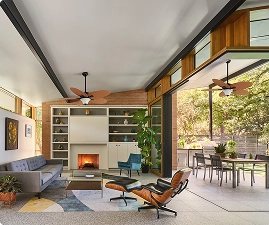





A DC fan can be an attractive choice when you want adjustable air movement, convenient controls, and sensible electricity use. But the letters on the motor label do not tell you how comfortable the finished room will feel. Blade design, mounting clearance, control electronics, installation quality, and daily operating habits all influence the result. A useful buying decision starts with those practical questions rather than an assumed percentage saving or a promise of silence.
This guide focuses on residential DC ceiling fans and uses a current 1stShine product as a concrete reference. It explains what to request from a supplier, how to compare performance on equal terms, and how to check the installation before accepting it. It also separates published product features from measurements that still need confirmation. That distinction matters when you are buying one fan for a bedroom or specifying a repeatable package for several apartments.
The goal is a fan that produces useful air movement at the speeds you actually use, fits the room safely, and remains straightforward to operate and service. A long feature list is only helpful when each feature supports that goal. Begin with the room, write down the required behavior, and then compare the complete fan system against that brief.
What a DC Fan Means for a Ceiling Fan Buyer
A residential DC ceiling fan generally uses an electronically controlled motor rather than relying on the same arrangement as a conventional AC induction fan. The home supply can still be alternating current. Electronics in the fan system convert and control the incoming power for the motor. You therefore should not assume that a product described as a DC fan connects directly to a battery, a solar panel, or a low-voltage lighting circuit.
The practical buying question is how the complete assembly behaves. Its motor, electronic controller, blades, bearings, housing, and mounting system work together. A DC label can indicate a useful design approach, but it cannot substitute for airflow data, input power, control compatibility, or a clear service plan. Two products using DC motors may deliver very different comfort, noise, and ownership experiences.
Compare the system rather than the motor name
Ask the supplier to identify the exact model and configuration behind every specification. A product family may contain several sizes, light packages, finishes, or receiver versions. A general statement about that family does not prove that the configuration in your quotation has the same electrical rating or functions. Keep the model identifier visible on the quotation, technical sheet, order confirmation, and eventual maintenance record.
For background on why several components matter together, review the ENERGY STAR page on ceiling fan performance components. Its useful lesson is that motor quality alone does not define the performance of the whole fan. Apply that same discipline to a DC comparison: inspect the blade assembly, mounting arrangement, speed range, and controller instead of treating one component as a guarantee of the final result.
Clarify what is included in the electrical package
Before ordering, ask whether the receiver, remote, mounting hardware, light source, and any required wall control are included. Confirm the rated input for the exact destination market from the supplied documentation. A product page describing a wide voltage range is a starting point for inquiry, while the label and installation instructions for the delivered model remain essential. Do not infer electrical compatibility from a product photograph or a similar model name.
A useful supplier reply connects each feature to an identifiable item in the package. If a remote is pictured but optional, that changes the actual purchase. If a receiver sits inside the canopy, its fit can affect installation. Resolving those details early makes the comparison more accurate and reduces the chance that an apparently inexpensive fan becomes a more complicated project after delivery.
Match DC Fan Airflow to the Room and People
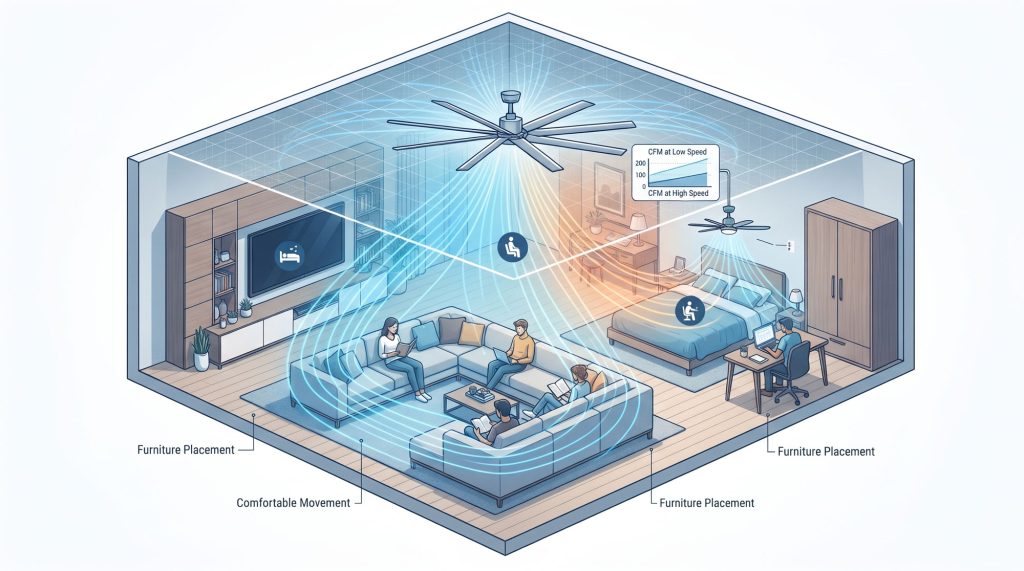
Start with where people sit, sleep, work, and move through the room. A ceiling fan produces air movement rather than refrigerated air. Its value depends on whether that movement reaches occupants comfortably. A fan centered on a drawing may be poorly positioned for a bed, a sectional sofa, or a work area. Sketch those locations before deciding that a particular diameter is automatically suitable.
Blade span helps describe physical size, while airflow describes delivered air volume under stated test conditions. Neither figure, by itself, describes every aspect of comfort. Airflow distribution, installation height, surrounding walls, and furniture can change the experience. When performance matters, ask for documented airflow at more than one speed and evaluate a sample in conditions that resemble the intended room.
Use diameter as a screening tool
Measure room length and width, ceiling height, and the available clearance around the proposed installation point. Include doors, tall cabinets, beams, bunk beds, and other obstructions. Then use manufacturer sizing guidance to shortlist fans. The ENERGY STAR ceiling fan basics page offers general sizing and mounting context, but model instructions and the actual installation conditions should guide the final choice.
A large fan does not need to run at maximum speed all the time. In some rooms, a larger assembly operating gently can provide the preferred experience; in others, its physical scale or clearance needs make it unsuitable. Compare practical occupied-zone comfort rather than assuming that either the largest diameter or the highest advertised airflow must be best. Where a room has separate activity zones, review placement before simply increasing size.
Separate measured airflow from impressions
A description such as strong breeze or high speed is not a standardized airflow measurement. Ask what was measured, at which speed, with which blade set, and under what applicable test method. If the supplier cannot provide the value, leave that item unresolved instead of converting a marketing phrase into a technical specification. This keeps assumptions visible and prevents them from becoming contractual promises later.
For projects where air delivery is the main selection criterion, compare the large and high CFM ceiling fan category as well as general decorative models. The purpose is to explore the right product family, not to assume every large fan solves every room. A suitable shortlist balances measured performance, physical fit, acceptable sound, and the lowest comfortable operating speed for the people using the space.
Calculate DC Fan Running Costs Without Guesswork
The most useful energy comparison uses the input power of the complete fan at comparable operating conditions. A maximum motor wattage alone is not enough if the products deliver different airflow or if one figure excludes electronics. Ask whether reported power includes the controller and whether the lighting load is separate. Keep those boundaries consistent before calculating a saving or ranking products.
Running energy is power multiplied by time. Convert watts to kilowatts, multiply by operating hours, and apply the electricity price relevant to the location. This provides a transparent estimate, not a guaranteed bill reduction. Occupancy, speed selection, light use, and standby behavior all affect actual use. Make the assumptions explicit so the estimate can be revised when better information becomes available.
Work through a clearly labeled example
Suppose two hypothetical fans meet the same comfort requirement while drawing 24 watts and 48 watts respectively. At eight hours per day for 180 days, the first uses 34.56 kilowatt-hours and the second uses 69.12 kilowatt-hours. The difference is 34.56 kilowatt-hours. At an illustrative price of 0.20 per kilowatt-hour, the seasonal difference is about 6.91 in the same currency. These numbers are examples, not measured specifications for a 1stShine product.
That result can help evaluate a price premium, but it does not justify a universal payback claim. If the fan runs fewer hours, the estimated saving falls. If the preferred operating speed changes, both power and comfort may change. If the installation includes a light kit, calculate its use separately. Compare a realistic ownership pattern rather than multiplying maximum wattage by every hour in the year.
Account for the speed you will actually use
A comparison at maximum output may be irrelevant for a bedroom where the fan normally runs gently overnight. Request low and medium speed data where available. Also ask about standby power for receivers or connected features if those loads matter to the project. A small continuous load and an occasional high load should be represented according to their own operating hours, rather than hidden inside one headline number.
Use the ENERGY STAR key product criteria page to understand why airflow and energy performance belong together. Certification and its metrics apply to qualifying models under the relevant program; a DC motor does not automatically mean a product is certified. Ask for a verifiable listing if certification is part of the purchasing requirement, and avoid transferring a label from one model to another in the same range.
Choose DC Fan Controls That People Can Use
Control design can make an efficient fan pleasant or frustrating. Decide who will operate it, how they will enter the room, and what should happen when power returns after an interruption. A remote can be convenient, but a missing remote should not leave occupants confused about basic operation. A connected app adds another interface, along with account setup, network, and support considerations that may matter more than a decorative finish.
Start with a simple sequence: turn the fan on, select a comfortable speed, operate the light if fitted, and turn everything off. Ask the supplier to demonstrate that sequence using the exact control package. Then test reverse, timer, pairing, and any memory behavior separately. This distinguishes ordinary daily use from configuration tasks that should be documented for the owner or maintenance team.
Do not assume an existing wall control is compatible
A wall control designed for another fan may not work with a DC controller. Use the model instructions and the supplier’s compatibility guidance. In particular, do not treat a conventional lighting dimmer as a general-purpose fan speed control. ENERGY STAR control and accessory guidance recommends matching controls to the fan and distinguishes control of the motor from control of the light.
If a room already has a wall device, record its make and model before ordering. Ask whether it must be replaced, bypassed, or retained only as an isolation switch by the installer. Get that answer in writing for the selected configuration. This is more reliable than asking whether a new fan works with ordinary wiring, because that phrase can conceal several very different installation conditions.
Test recovery as well as normal operation
A short interruption can expose behavior that a showroom demonstration misses. Does the fan restart, remain off, or return to a stored speed? Does the light come on independently? Does a receiver need pairing again? These answers are model-specific. Record what the supplied instructions say and, when appropriate, confirm the behavior during commissioning without improvising electrical work or bypassing protective devices.
For households, a visible and consistent control routine is often enough. For hospitality or rental use, instructions should also explain where a replacement remote comes from and who manages any account credentials. Explore the smart and modern ceiling fan range if connected functions are relevant, but choose connectivity only when it improves the intended routine. More control methods do not automatically create a clearer experience.
Assess DC Fan Sound at Useful Operating Speeds
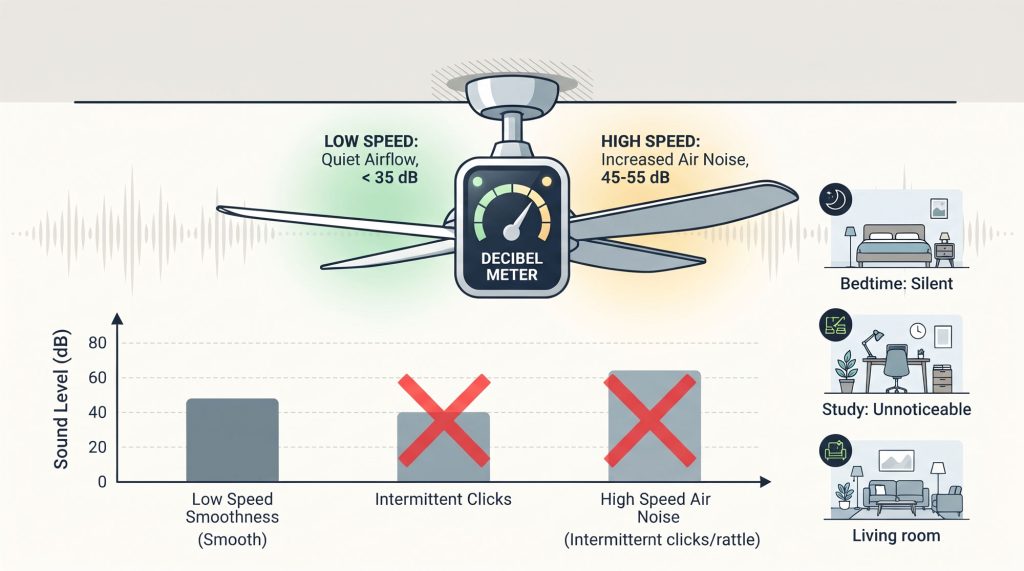
A quiet motor is desirable, but total sound includes more than the motor. Moving air, blade alignment, mounting vibration, loose components, and surrounding room acoustics can all contribute. Product language such as silent should be treated as a feature description until the supplier provides a measurement with meaningful conditions. Avoid promising a particular noise level based on the DC label alone.
The relevant question is whether the fan is acceptable for the activity taking place beneath it. A study, bedroom, television room, or busy living area can have different expectations. Evaluate low-speed smoothness and any intermittent clicks as well as high-speed air noise. A steady broadband sound and a repeating rattle may be equally audible yet produce very different reactions for a person trying to sleep.
Ask how a noise claim was established
If sound level is a selection criterion, request the measurement distance, speed setting, background conditions, and method behind the claim. A bare decibel number without context is hard to compare. Do not rank one fan against another if their published numbers describe different distances or operating states. Mark missing conditions as missing instead of filling them with an assumption that makes the products appear equivalent.
A sample evaluation should reproduce the intended use reasonably well. Listen from normal seating or sleeping positions, with the fan at the speed likely to be used for long periods. Check whether nearby lights, ceiling panels, or fittings vibrate. Note which sounds are present before the fan starts so unrelated room noise is not incorrectly attributed to the product or used to mask a problem.
Resolve vibration before judging the motor
Installation and assembly checks should follow the manufacturer’s process. Loose hardware, blade attachment issues, or inadequate support can produce vibration that is not solved by changing the remote setting. Have a qualified installer investigate persistent wobble or abnormal sound. Do not bend blades, add improvised weights, or alter the mounting system beyond the approved instructions in an attempt to force an acceptable result.
The bedroom and quiet ceiling fan collection can help narrow models intended for rest spaces, while the final decision still needs model-specific information. Ask whether audible control tones, indicator lights, and receiver behavior can be adjusted if those details matter at night. A thoughtful bedroom specification considers the entire experience: gentle airflow, unobtrusive light, clear controls, and acceptable sound together.
Check DC Fan Mounting and Installation Before Ordering
The mounting decision affects both safety and performance. Record ceiling height, ceiling shape, structural support, existing electrical location, and the complete installed drop of the selected fan. A product’s overall height is useful only when you understand where the measurement starts and ends. Check clearance to the lowest relevant component as described in the instructions, including a light fixture if fitted.
A flush-mount fan can help where vertical space is limited, but it does not eliminate clearance requirements. A downrod arrangement may be appropriate for a taller ceiling, provided the rod, wiring, canopy, and mounting system are approved for the model. Do not combine components from unrelated products simply because they appear to fit. The correct assembly needs traceable compatibility as well as a satisfactory appearance.
Resolve the existing condition early
Ask a qualified installer to review support and wiring before making the final purchase when those conditions are uncertain. A decorative light fitting does not prove that the existing support is suitable for a rotating fan. Likewise, a ceiling opening does not tell you which control arrangement the wiring can support. A short survey can identify work that otherwise becomes a surprise after the product arrives.
For a sloped ceiling, confirm the approved angle and any required adapter rather than assuming a standard canopy will accommodate it. For a high ceiling, check access for assembly, cleaning, and future repairs. Include those tasks in the installation plan. A fan that can be installed once but cannot be serviced conveniently may create a larger ownership burden than its purchase price suggests.
Keep indoor and outdoor suitability distinct
The selected model in this guide is presented for indoor use. Do not extend that description to exposed outdoor locations. Damp and wet suitability require the appropriate documented rating for the exact assembly. A corrosion-resistant finish or plastic blade material does not, by itself, establish protection for the motor, receiver, connections, or lighting. Ask for the applicable product documentation before placing a fan in a demanding environment.
The all-weather outdoor ceiling fan category is a better starting point for projects involving humidity or weather exposure, while each candidate still needs a rating check. For indoor installations, review the easy installation and low maintenance range if access or maintenance effort drives the brief. These categories organize the search; they are not replacements for the supplied instructions or a site-specific installation assessment.
Evaluate a Real DC Fan Product Without Inventing Specs
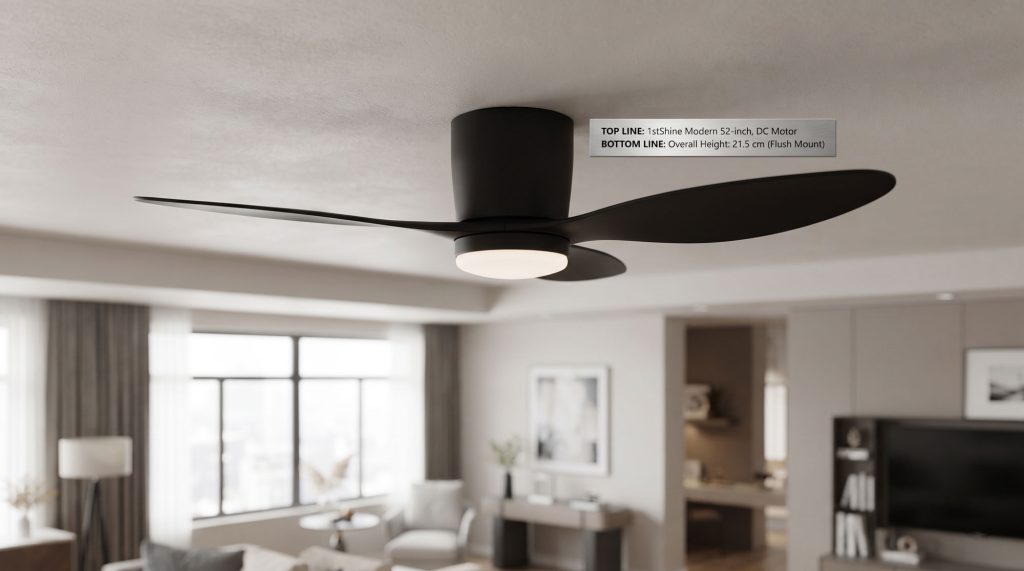
The reference product is the 1stShine Modern 52-inch 6 Speed Ceiling Fan Timer Function. Its current page describes a DC motor, six adjustable speeds, a timer, and reversible operation. The displayed 52-inch configuration lists a 132 cm diameter, a 21.5 cm overall height, an integrated LED light, and flush mounting. The page also displays a separate 42-inch option, so the selected size must be stated clearly when requesting a quotation.
Those published features support a practical shortlist for an indoor room where flush mounting and several speed choices are useful. They do not establish an independently measured airflow value, a sound level for your room, or a quantified energy saving. Treat the product as a candidate to evaluate against the brief. Ask the supplier to confirm the ordered configuration and provide the missing information before making performance commitments.
Translate page features into purchasing questions
For the six speed settings, ask for the available airflow and input power data, plus the method used to change speeds. For the timer, ask what durations are available and whether it controls the fan, light, or both. For reversible operation, ask how reverse is selected and what operating sequence the instructions require. Each question turns a broad feature into behavior that can be checked at delivery.
For the integrated LED, ask about light output, color options, replaceability, and the included control functions. This article does not assume dimming simply because an LED is integrated. For voltage, obtain the rating and documentation for the actual supplied variant even though the page describes a broad input range. For mounting, request a dimensioned drawing so the installed position can be assessed against the room rather than estimated from photography.
Define an acceptance sample
For a repeated installation, arrange a sample that matches the intended finish, size, control package, and light option. Keep its model identifier and document any approved deviations. A sample in a different size can help discuss appearance, but it should not be used as proof of the selected configuration’s airflow, acoustic behavior, or installed height. That discipline is particularly useful when several visually similar variants share a product page.
Once accepted, use the same configuration description on purchase orders and handover documents. Record any later substitution and assess whether it changes the brief. A different receiver may change control behavior even if the blades look identical. A different light module may affect service parts. Product selection works best when the approval trail describes the whole fan rather than only the attractive face shown in a catalog.
Build a DC Fan Comparison and Ownership Checklist
A comparison table should make uncertainty visible. Put verified values beside their source and keep open questions separate from preferences. This prevents an incomplete technical sheet from appearing equal to a fully documented one simply because both products have a DC motor. Use a consistent basis for all shortlisted models: the same room, similar useful airflow, equivalent lighting assumptions, and the control package actually included in the price.
| Criterion | What to request | How to use the answer |
| Exact configuration | Model, size, finish, receiver and light option | Keep quotations and delivered items comparable |
| Airflow and power | Documented values at stated speeds | Compare useful output and running energy together |
| Montaje | Drawing, installed drop and compatible hardware | Check room fit before ordering |
| Controls | Included devices, compatibility and recovery behavior | Match daily operation to the occupants |
| Service | Parts availability, warranty scope and support route | Assess the ownership burden beyond purchase price |
Include costs that arrive after purchase
Installation access, replacement controls, light modules, shipping, and service labor can affect ownership. Ask which items are covered by warranty and which costs remain with the owner. A long headline warranty may apply to one component while other parts have different terms. Read the actual policy for the offered configuration and market instead of assuming one duration covers the whole installed system.
For a multiroom project, consider spare parts and configuration consistency. A shared remote platform may simplify support if it is deliberately planned; it may create confusion if pairing and room identification are poorly documented. Label maintenance records with room location and full model details. Keep a controlled copy of installation instructions and the supplier contact so future repairs do not depend on a single person’s memory.
Make the handover usable
- Record the exact fan model, size, finish, and controller supplied in each room.
- Keep the operating instructions, warranty terms, and replacement-parts contact together.
- Document the normal speed and control routine without requiring an app account for guests.
- Record any commissioning issue and its resolution before accepting the installation.
- Separate verified specifications from supplier questions that remain open.
A maintenance plan can remain simple. Identify who cleans the fan, how access is provided, and which checks the instructions recommend. Do not invent lubrication or electronic servicing procedures for a sealed assembly. Where repair is needed, follow the manufacturer process and use appropriate replacement parts. The best plan is one that the owner can actually carry out while preserving a clear record of what was supplied and changed.
Compare offers with a simple decision record
Before choosing between two finalists, write a short decision record that names the room, preferred operating condition, acceptable compromises, and unresolved questions. For example, one model may offer a more convenient timer while another has clearer service documentation. State which difference matters to the owner and why. This makes the purchase defensible without pretending that every feature can be reduced to a single score. If a required specification is missing, keep it as a condition of approval rather than awarding an optimistic rating.
Keep commercial and technical approval connected. A quotation should identify the same model and options that were evaluated, together with delivery terms, included accessories, and the route for resolving damaged or incorrect items. If the supplier offers an alternative after approval, compare the changed specifications before accepting it. A substitute that looks almost identical can still have a different controller, installed height, or light module. Clear records reduce unnecessary argument because both sides can see the configuration that was actually requested.
After installation, revisit the original room brief with the occupant or project representative. Confirm that normal use is understandable, the comfortable speed is easy to select, and the timer behaves as expected. Record any mismatch as a specific observation, such as an unwanted restart or a control button that does not respond consistently. Specific observations give the installer and supplier something they can investigate. They are more useful than a broad conclusion that the motor technology itself is good or bad.
Conclusion: Choose a DC Fan by Verified Room Performance
A well-chosen DC fan matches useful airflow, acceptable sound, sensible running power, compatible controls, and safe installation to the needs of a particular room. The motor technology is part of that decision, while the complete system determines the lived experience. Use measured data where available, identify what remains unknown, and compare products at realistic operating conditions rather than relying on a universal saving or silence claim.
For the reference 52-inch six-speed model, the published features provide a useful starting point: a DC motor, multiple speeds, timer, reverse, integrated LED, and flush mounting. The next step is to confirm the exact variant and obtain the performance and installation documentation needed for your project. This preserves the difference between an appealing shortlist and an approved specification, without making the buying process unnecessarily complicated.
If you are planning a home, rental, or multiroom installation, contact 1stShine with your room dimensions, ceiling height, preferred mounting style, intended operating hours, and control requirements. Ask for a configuration-specific quotation, supporting technical data, and a suitable sample plan. That brief gives the supplier a practical basis for recommending a fan and gives you a clear checklist for evaluating the result before purchase.