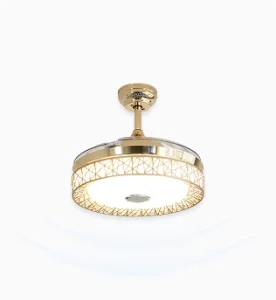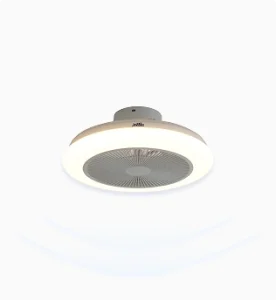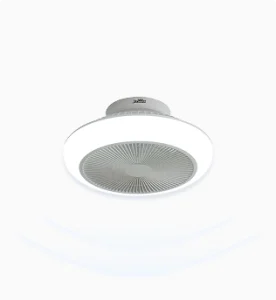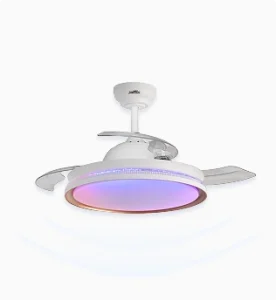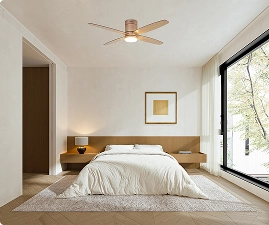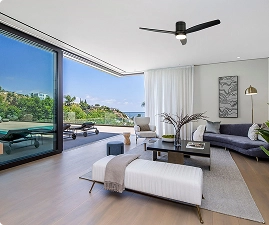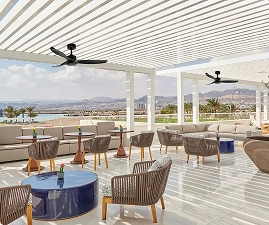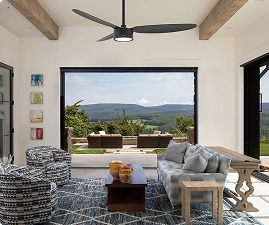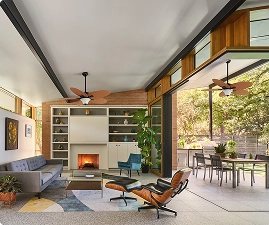





An ABS blade ceiling fan can offer a molded shape, a coordinated finish, and a practical surface for routine care. Those advantages are worth considering, but the material name is not a complete product specification. It does not tell you the airflow, acoustic performance, outdoor suitability, or service life of the finished fan. A good purchase connects the blade material to the complete assembly and the room where it will be used.
This guide explains what ABS means, which claims need model-specific evidence, and how to evaluate cleaning, appearance, balance, replacement, and ownership before ordering. It uses a current 1stShine product as a reference: the IBCF-D02BT ceiling fan with retractable ABS blades and an integrated speaker. The example makes the questions concrete without assuming that every ABS fan shares its features or that a product description is an independent laboratory test.
The intended reader is a homeowner, designer, installer, or project buyer comparing indoor ceiling fans. Start by identifying the room, the exact model, and the maintenance routine the owner can realistically support. Then ask for the information that connects material choice to actual use. That sequence keeps the decision focused on useful performance and avoids paying for a reassuring material label while overlooking a control, clearance, or service issue that matters more.
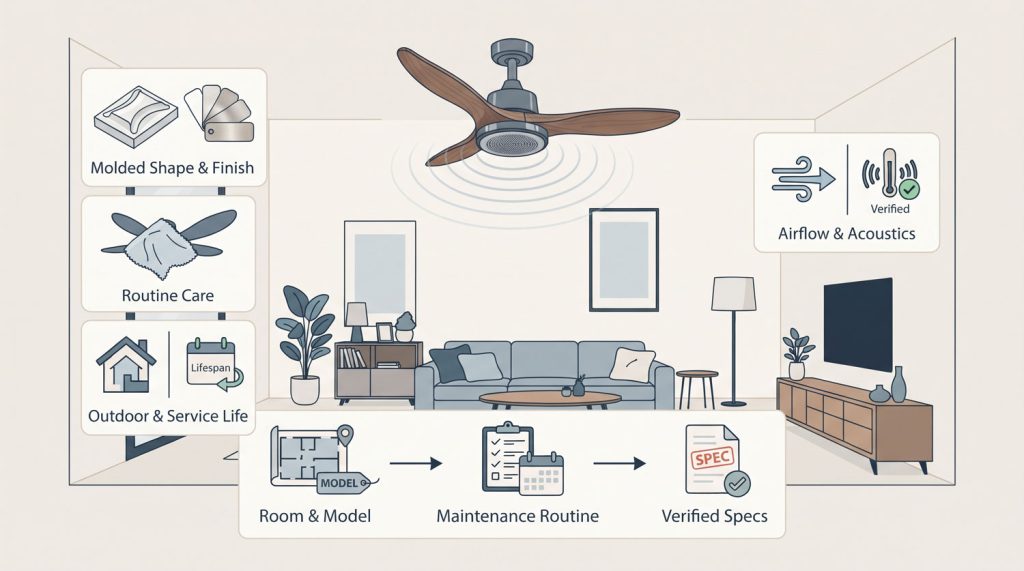
What ABS Blade Means in a Ceiling Fan Specification
ABS is the abbreviation for acrylonitrile butadiene styrene, a family of engineering thermoplastics. Resin producers offer grades with different property balances, processing behavior, and intended applications. A reference to ABS therefore identifies a material family rather than one universal recipe. The final blade also depends on its geometry, manufacturing process, finish, attachment design, and the way the completed component is controlled and inspected.
The INEOS Polymers ABS overview describes a material used across household appliances and other manufactured products, with molding among its common processing routes. For a fan buyer, the practical lesson is that ABS can support repeatable shaped parts and attractive surfaces. That general background does not identify the resin supplier, grade, recycled content, or test results of a particular fan. Request those details only where they are relevant to the specification, and do not attribute them without evidence.
Ask which part of the blade assembly is ABS
A fan may combine an ABS blade body with metal fasteners, mounting parts, decorative coatings, or a retracting mechanism. Clarify whether the description applies to the visible blade, a trim piece, or the whole blade assembly. This is particularly useful when a product uses an enclosed or retractable design, because the parts hidden inside the housing can influence cleaning access and future replacement even though they are not prominent in photographs.
Ask the supplier to identify the exact model and blade option on the quotation. Similar housings can be offered with different blade sizes or finishes, and those configurations should not be treated as interchangeable. Keep a drawing, image, or part identifier with the approval. It gives the receiving team something specific to compare with the delivered item and helps the owner describe the right replacement component later.
Separate a material statement from a performance guarantee
A material label is a useful starting point, not proof of a particular airflow value, sound level, impact resistance, or lifespan. Those outcomes belong to the finished design and its documented conditions. If a feature matters enough to influence the purchase, ask how it is supported. A supplier can then provide model data, explain a limitation, or propose a sample rather than leaving the buyer to convert a broad material description into an unsupported promise.
The ceiling fan glossary can help distinguish blade material from terms such as pitch, diameter, and rotational speed. Use that vocabulary to make the inquiry precise. Asking whether a blade is ABS answers a composition question; asking whether the fan delivers the required airflow at an acceptable speed answers a performance question. Keeping those questions distinct makes quotations easier to assess and keeps missing information visible.
How ABS Blade Geometry Affects the Buying Decision
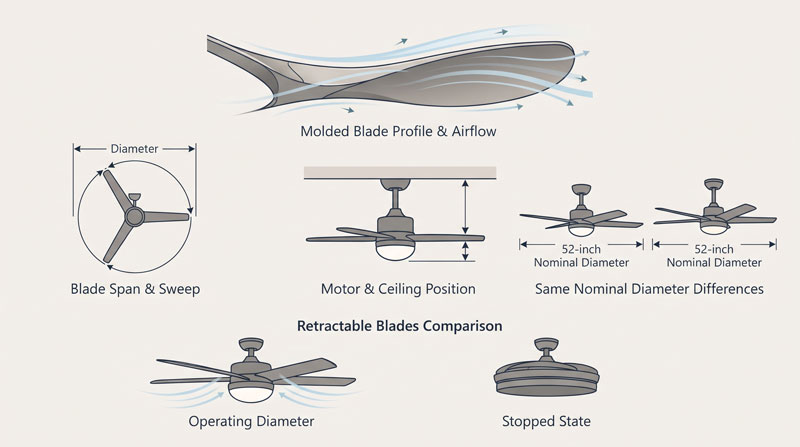
Molded blades can incorporate curved surfaces, changing profiles, and integrated details that would be difficult to describe with one flat dimension. A shape may support a particular aesthetic or aerodynamic design, but its effectiveness still needs to be assessed as part of the whole fan. A sculpted profile does not automatically outperform a simpler blade, and an attractive silhouette is not a substitute for documented air delivery.
Look at the blade span, sweep, and position relative to the motor and ceiling. Then consider whether those dimensions suit the room and furniture. Two fans with the same nominal diameter can differ in overall height, blade profile, and light position. For a retractable assembly, also ask which diameter applies when the blades are operating and which dimensions describe the stopped appearance. Both states can matter to the room layout.
Compare approved configurations rather than visual similarities
If a product comes in several sizes, request the drawing and performance information for the selected size. Do not assume that a photograph shows the configuration quoted or that the airflow of a larger version applies to a smaller one. Where several finishes use different surface treatments, ask whether the same technical data covers them. A short, configuration-specific answer is more useful than a generic brochure covering an entire decorative collection.
The ceiling fan product collection is a sensible starting point for comparing forms, while the final shortlist should be narrowed to identifiable configurations. Record each model, blade span, mounting method, and control package. This record helps reveal whether a comparison is truly between equivalent options or between products serving different needs. It also prevents an accessory or optional feature shown in an image from being assumed included in the price.
Do not modify blades to change the airflow
Changing the blade shape, drilling additional holes, trimming an edge, or substituting a visually similar part can alter the approved assembly. Follow the manufacturer’s replacement and maintenance instructions rather than treating a blade as a generic sheet of plastic. If the delivered shape appears different from the approved sample, raise the discrepancy with the supplier before installation. Modification is not a reliable way to reconcile an incorrect part with the original specification.
For a project with a strong decorative brief, compare the intended appearance at normal viewing positions and under the room lighting. A blade that looks substantial in a close product image may appear quite different overhead. Keep appearance observations separate from technical approval: one can be assessed with a visual sample, while the other needs compatible components, relevant documentation, and an installation that follows the supported arrangement.
Evaluate ABS Blade Airflow Without Material Shortcuts
Airflow comes from the interaction of blade geometry, motor operation, rotational speed, diameter, and the mounting conditions of the complete fan. ABS identifies one part of that system. It does not provide a universal conversion to CFM or establish that a fan will be quiet at its highest speed. Compare measured product information wherever available, with every value tied to a stated configuration and operating condition.
The ENERGY STAR performance components guidance emphasizes that several components influence fan performance together. Apply that system perspective when comparing ABS with wood, metal, or another blade material. A material-based ranking can be misleading if the fans differ in size, speed, design, and electrical input. The better question is which complete model meets the room’s requirements with the desired control range and acceptable ownership effort.
Ask for useful operating points
Maximum airflow describes the upper range, but the everyday setting may matter more. Request airflow and input power at relevant speeds when those data are available. For a bedroom, gentle low-speed behavior can be central to comfort. For a living space, a broad usable range may be more valuable. Record which settings were evaluated so a pleasant showroom demonstration can be connected to the actual supplied control package.
A simple comparison table should not combine one fan’s maximum airflow with another fan’s low-speed power. Nor should it borrow an acoustic figure from a different size. If data are missing, label the item as pending and ask for clarification. This protects the buyer from a false sense of precision and gives the supplier a clear opportunity to provide the evidence needed for a fair comparison.
Keep blade material and motor efficiency distinct
A light-looking blade does not establish the electrical efficiency of the fan. The control electronics, motor, blade loading, speed, and measurement boundary all matter. If running costs are part of the decision, calculate them from documented input power and realistic operating hours. Keep the lighting load separate where appropriate. Avoid stating a percentage energy saving simply because one fan uses ABS and another uses a different visible material.
The energy efficient and budget ceiling fan range can help organize products when operating cost matters, while the large and high CFM range helps explore air-delivery options. These categories are search aids, not performance certificates. Confirm the exact model data and any certification claims before using them in a purchasing specification. A good decision combines suitable output, reasonable power use, and a room layout where occupants can benefit from the air movement.
Check ABS Blade Finish and Appearance Before Ordering
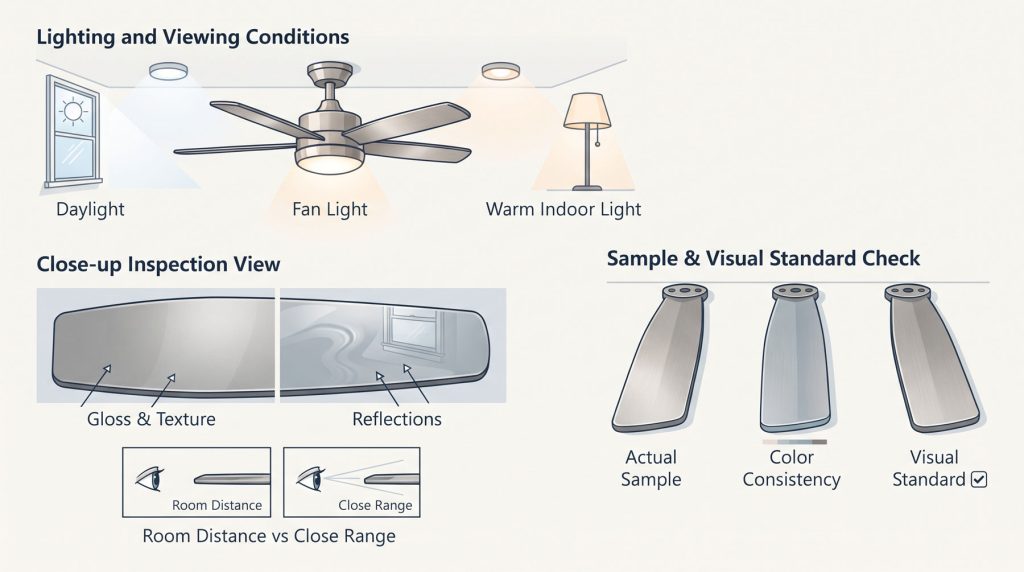
Surface finish influences how a fan looks in daylight, under its own light, and beside surrounding fixtures. A molded blade can be presented in solid colors or decorative effects, but the finish name alone does not explain the coating system or maintenance requirements. Request an actual sample when color consistency is important, especially for a repeated installation where several fans will be visible together.
Inspect the blade from normal room positions as well as at close range. Gloss, texture, and reflections can change the impression of color. A finish that coordinates well with a canopy in a catalog may look different under warm indoor lighting. This is an appearance assessment rather than a defect diagnosis. Agree the relevant visual standard with the supplier so delivery checks do not depend on an uncalibrated screen image or a vague memory of a showroom.
Distinguish molded color from a surface treatment
Ask whether the visible appearance comes from the base material, a paint or coating, or another decorative process. The answer can affect cleaning instructions and how small scratches appear. It should not be used to invent a durability ranking without supporting evidence. Instead, use it to identify the right care method and any handling precautions recommended for the supplied finish.
For commercial orders, keep an approved finish reference and record which components it covers. The blade, motor housing, canopy, and downrod may use different materials and processes. Slight differences can be acceptable or unacceptable depending on the design brief. Resolve that expectation before ordering a large quantity, and ask how the supplier handles replacement parts when matching a later production batch is important to the owner.
Avoid making an untested scratch-resistance promise
A general statement that a resin is useful for attractive, durable surfaces does not establish the scratch behavior of every painted blade. Abrasive cleaning, accidental contact, and the coating itself can all affect appearance. Ask for the manufacturer’s care guidance and any relevant test information when surface performance is a contractual requirement. An approved sample and a clear handling routine often provide a better basis for acceptance than a broad adjective.
The luxury and premium ceiling fan collection may offer finishes that fit a decorative project, while the technical material questions remain the same. Choose an appearance the owner likes, but also confirm how it should be cleaned, what replacement options exist, and which configuration was approved. That combination supports an attractive installation that remains manageable after the original purchase rather than treating the finish as a one-time styling decision.
Clean ABS Blades Using the Model Instructions
The easiest cleaning routine is the one the owner can perform safely and consistently. Before buying, ask how the selected fan should be isolated, reached, wiped, and returned to service. The material name does not authorize a particular detergent or solvent. Coatings, printed effects, neighboring components, and the integrated light can have care limits that differ from the underlying plastic. Follow the model instructions for the complete assembly.
For routine care, obtain the recommended cloth type, cleaning method, and any product restrictions from the supplier. Do not assume that a kitchen degreaser, disinfectant, polish, or alcohol-based cleaner is compatible with the finish. If a cleaning product is not addressed, ask before using it. This is especially relevant in hospitality or managed properties where a standard housekeeping chemical might otherwise be applied to every visible surface.
Make access part of the purchase brief
A fan that is straightforward to wipe at an accessible height can become difficult to maintain beneath a high or obstructed ceiling. Plan the access equipment and floor space needed for cleaning. Do not rely on a bed, chair, or other improvised platform. In a repeated installation, decide who is responsible and how often the condition will be checked, using the manufacturer’s instructions and the actual environment rather than an invented universal interval.
Retractable blades need a clear model-specific cleaning procedure. Ask how the blades can be accessed without forcing the mechanism and whether any parts must remain dry. A concealed stopped appearance can reduce visual clutter, but it does not mean that the hidden surfaces never collect dust. Keep mechanism care and blade-surface cleaning distinct so a simple wipe does not become an unsupported adjustment to a moving assembly.
Record the approved cleaning method at handover
Give the owner a short care note linked to the actual model instructions. Include the isolation method, access arrangements, and cleaning restrictions that apply. A useful handover tells the person doing the work what to use and where to ask questions. It should not require them to interpret a generic statement about engineering plastics or search through several unrelated brochures to identify which finish they have.
The easy installation and low maintenance ceiling fan category is useful when upkeep is a deciding factor. Compare models by the actual routine and service access they require, not by a claim that one blade material is maintenance-free. A fan contains more than blades, and a manageable cleaning surface does not eliminate the need to follow the instructions for the motor assembly, mounting components, controls, and any integrated lighting or audio features.
Assess ABS Blade Suitability for Humidity and Sunlight
Indoor rooms, humid covered spaces, and exposed outdoor locations create different demands. An ABS blade description does not establish the environmental rating of the whole fan. The motor, receiver, connections, light, hardware, and finish also need to be suitable. If the proposed location is outdoors or regularly damp, request documentation for the exact assembly instead of extending an indoor description to conditions it does not explicitly cover.
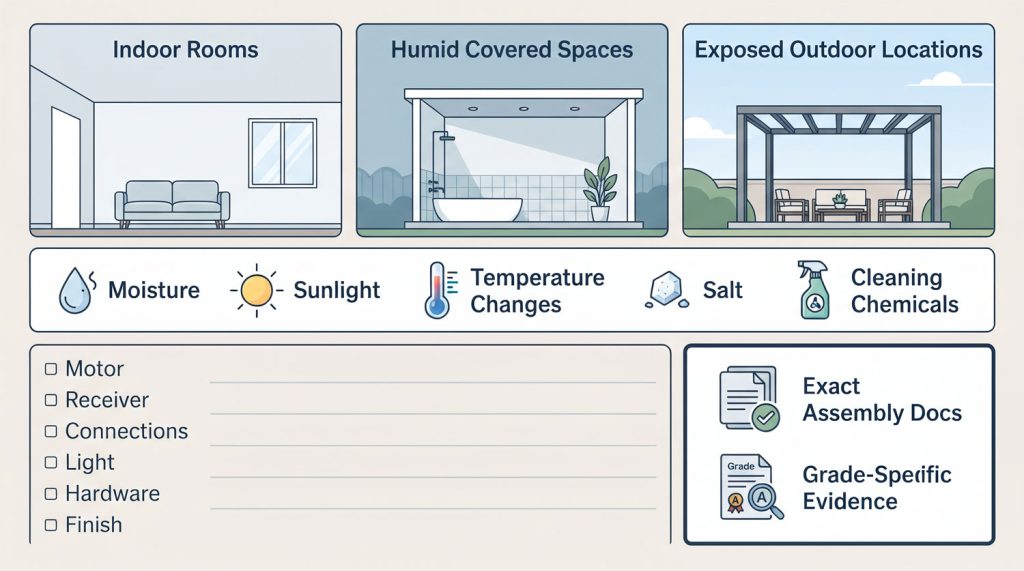
Weather resistance is also not a single property. Exposure can include moisture, sunlight, temperature changes, salt, and cleaning chemicals. Different grades and finish systems may address these conditions differently. Describe the site to the supplier and ask whether the specific model and accessory package are approved for it. A broad claim that plastic does not rust does not answer whether the entire fan can be used safely and reliably in that location.
Ask for grade-specific evidence when it matters
If sunlight exposure is a serious design condition, request relevant information for the finished blade and coating rather than relying on the abbreviation ABS. Resin producers publish different families and grades for different needs. The INEOS Styrolution advanced styrenics information, for example, distinguishes product families with different property profiles. This reinforces the need to identify the actual supplied system instead of assigning outdoor performance from a general material label.
Do not infer a service life from an isolated laboratory property or a similar resin’s brochure. Test conditions, pigment, coating, blade geometry, and use can differ. If the supplier cannot support the intended exposure, consider an alternative product or location. It is better to resolve suitability before ordering than to treat discoloration, corrosion elsewhere in the fan, or another environmental issue as an unavoidable consequence after installation.
Keep the complete product rating central
Use the all-weather outdoor ceiling fan collection as a starting point for outdoor projects, then verify each candidate’s documented rating and installation instructions. A covered patio is not necessarily protected from all rain or condensation. Explain whether wind-driven moisture, coastal conditions, or strong direct sun are present. The supplier needs the actual exposure brief to recommend a configuration rather than guessing from the word outdoor.
For the indoor reference product discussed later in this guide, the article does not claim outdoor suitability. Its ABS blades and indoor feature set are evaluated in that context. This boundary keeps the product discussion accurate and prevents a general materials explanation from becoming an unintended recommendation for a demanding environment. A suitable material choice and a suitable complete appliance are related decisions, but both need their own evidence.
Understand ABS Blade Balance, Damage and Replacement
A blade assembly rotates as part of a matched system. Shape, mass distribution, attachment, and manufacturing consistency can influence the behavior of that system. A visible wobble or unusual sound should be investigated through the manufacturer’s process, not attributed automatically to ABS or corrected by improvised modification. Several installation or component issues can produce similar symptoms, so the first step is to identify the actual condition.
Ask what the manufacturer recommends if a blade is cracked, visibly distorted, loose, or damaged during handling. Do not continue treating a damaged component as a cosmetic issue without appropriate guidance. Equally, do not assume every mark means the entire fan needs replacement. A clear support route helps the owner distinguish a finish concern from a component or assembly issue that requires inspection by a suitable technician.
Replace approved components, not approximate shapes
Request the exact replacement part identifier and ask whether blades must be replaced as a matched set. The answer can vary by design. Diameter, hole spacing, color, and apparent shape are not enough to establish compatibility. A retractable assembly may also include joints and other mechanism parts that require a defined replacement procedure. Keep the model and revision information available so the supplier can identify the supported component accurately.
Never bend, trim, drill, or heat a blade in an attempt to make it match another one. Such actions can change geometry and material condition beyond the approved design. If a delivery appears inconsistent, document the issue and ask the supplier how to proceed before installation. The objective is to restore the supported configuration, not to make a mismatched set look superficially uniform while leaving the underlying performance uncertain.
Plan spare parts for repeated installations
For apartments, guest rooms, or other multiroom projects, ask how long relevant parts are expected to be available and how changes between revisions are handled. Do not assume a later blade will fit simply because the product name remains similar. A maintenance record should connect room location, full model identifier, blade configuration, finish, and supplier order reference. This makes a future inquiry specific enough for the supplier to answer efficiently.
A small spare-parts plan can be more valuable than an elaborate list of features the owner rarely uses. Consider which components are practical to retain, how they should be stored, and who is authorized to arrange repairs. Keep the installation and maintenance instructions with the record. That preparation reduces the risk that a future repair becomes an unsupported substitution made under pressure because nobody can identify the original assembly.
Compare ABS Blades With Other Material Options
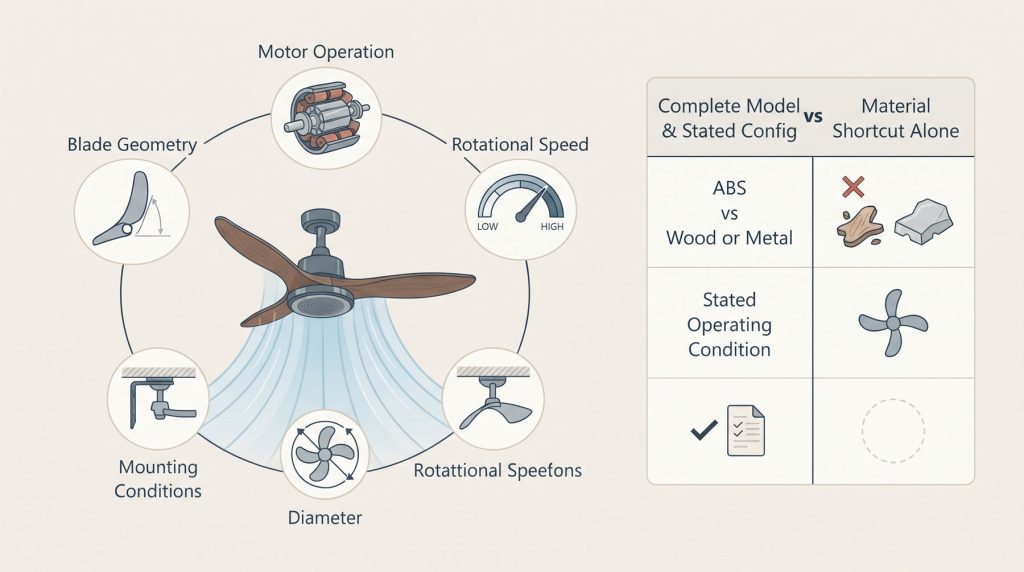
Material comparisons work best when they start with the project requirements. Wood can provide a particular appearance, metal can suit another design brief, and molded plastics can support different profiles and finish effects. None of these descriptions establishes a universal winner. Compare complete models that meet the same room, mounting, environmental, and control requirements before deciding that the visible material explains all of the difference in price or performance.
For each candidate, record the actual blade material, finish, approved use conditions, cleaning instructions, performance data, and replacement route. Keep unknown items marked as questions. A comparison that fills every blank with an assumption can look professional while being less reliable than a short table that clearly identifies what is missing. The purpose is to make a defensible purchase, not to produce a complete-looking scorecard regardless of evidence.
| Decision area | ABS blade question | What a useful answer includes |
| 재료 | What is the exact supplied blade configuration? | Model, blade option and relevant documentation |
| 성능 | Which airflow and power values apply? | Stated speeds, test basis and matching configuration |
| Finish | How is the appearance produced and maintained? | Approved sample and care instructions |
| Environment | Where can the whole fan be installed? | Documented rating for the selected assembly |
| Replacement | Which parts restore the approved configuration? | Part identifiers, set requirements and service route |
Compare ownership rather than only purchase price
An inexpensive fan can require a control accessory, difficult access, or a less convenient replacement process. A more expensive model may add features the room does not need. Keep those trade-offs visible. Ask which items are included and which are optional, and compare the installed configuration rather than two headline prices. This is especially useful for a multifunction product where lighting, audio, and control packages can complicate an otherwise simple material comparison.
For sound-sensitive spaces, use the bedroom and quiet ceiling fan range to explore options, then request relevant acoustic information or a sample. For decorative projects, consider the vintage and industrial style collection alongside modern forms. The categories help find products, but they do not remove the need to verify the selected model’s actual materials, intended use, and supported mounting arrangement.
Use a sample to resolve the right uncertainties
A visual sample can answer finish and proportion questions, while a representative operating sample can help assess controls, perceived sound, and useful air movement. Neither replaces every technical document. Decide what each sample is intended to demonstrate and record the conditions. If the purchase requires a measured threshold, request suitable evidence instead of treating an informal room impression as an equivalent laboratory test.
Review the IBCF-D02BT ABS Blade Product Example
The 1stShine Hi-Fi Sound Quiet Premium Ceiling Fan with Speaker is listed with SKU IBCF-D02BT. Its current page describes retractable ABS blades, a BLDC motor, six speed choices, reversible rotation, remote operation, integrated LED lighting, and a built-in speaker. The displayed size is 42 inches, with a listed diameter of 107 cm, overall height of 42.5 cm, and downrod mounting. These are published product details rather than measurements independently taken for this article.
This configuration is relevant to an indoor buyer who wants a concealed stopped blade appearance and several functions within one ceiling fixture. The page does not make every material question disappear. Ask for the selected finish, exact mounting drawing, compatible accessories, care instructions, and replacement process. Those items connect the ABS blade description to an actual configuration the buyer can approve, install, and maintain.
Ask how the retractable ABS assembly is serviced
A retractable design adds operating and stopped states, along with mechanism-related questions. Ask how the blades should be accessed for cleaning, whether a replacement is supplied as a complete assembly, and what the instructions say about unusual movement. Do not force the blades or infer a manual adjustment procedure from a product photograph. The supported maintenance method should come from the manufacturer for the actual model.
Keep the 42-inch operating diameter and the full installed drop separate from any stopped dimensions. Ask for missing dimensions where they affect furniture, clearance, or appearance. The product page’s ceiling-to-top-of-blade entry does not provide a numerical value, so it should not be replaced with an estimate derived from the overall height. A configuration drawing is the right way to resolve that gap before installation.
Verify multifunction details independently of the blade material
The page describes a built-in speaker and remote operation, but a buyer should still confirm audio connection requirements, supported controls, and the supplied package for the intended market. Do not infer sound quality measurements, wireless protocols, or network features from the general product name. Similarly, obtain lighting output and control details if the fixture is expected to provide the main light for the room. Those functions need their own evidence even though they share a housing with the ABS blade assembly.
The product page lists broad voltage compatibility and several certification names. Obtain the relevant documentation for the exact supplied variant and destination market rather than treating the list as proof that every configuration has every approval. A careful specification identifies what is supplied and what is verified. It can still recognize the convenience of a multifunction design without converting an appealing feature list into a set of unsupported technical guarantees.
Specify and Accept an ABS Blade Ceiling Fan
A useful procurement brief describes the room, the exact fan configuration, the intended environment, the required functions, and the questions that must be resolved before approval. Keep the blade material in that record, together with finish, size, mounting, controls, lighting, and any audio option. This makes the quotation easier to assess and reduces ambiguity if the supplier proposes a substitute or changes a component between sample approval and final delivery.
For a repeated order, maintain a room schedule and an approved configuration reference. Include the supplier order number and any agreed exceptions. A sample in one finish or size should not silently authorize a different option when the change affects the installed dimensions, supported accessories, or replacement parts. Clear records support both the purchasing decision and the later maintenance process, when the original design discussion may no longer be fresh in anyone’s memory.
Use a practical receiving and installation checklist
- Match the delivered model, size, blade option and finish to the approved quotation.
- Check for visible shipping damage and report missing or incorrect components before installation.
- Keep the approved mounting hardware and instructions with the correct room package.
- Confirm normal operation using the supplied controls after a qualified installation.
- Document cleaning guidance, replacement-part identifiers and the supplier support contact.
Inspect components without inventing a destructive acceptance test. A household buyer should not flex, strike, heat, or chemically expose a blade to see whether it matches a general plastics claim. If a contractual material property matters, agree an appropriate evidence requirement or test process with the supplier. A delivery inspection should confirm identity, condition, completeness, and the agreed documentation rather than creating damage that makes later assessment harder.
Keep the handover usable for the owner
Provide a short operating and care summary linked to the actual instructions. Identify the normal control routine, cleaning access, and the route for addressing unusual sound or movement. If the fan includes a speaker or integrated light, explain those functions separately so a question about audio is not confused with motor operation. Keep the full model identifier easy to find, especially where several similar-looking fans are installed across a property.
Conclusion: Choose ABS Blades With the Whole Fan in Mind
An ABS blade ceiling fan should be selected as a complete product, with material, geometry, finish, mounting, controls, and service considered together. The material can support an appealing molded design, but it does not independently establish airflow, silence, weather suitability, or lifespan. Ask for evidence tied to the exact configuration and keep missing information visible until the supplier resolves it. That approach produces a more useful decision than a simple ranking of plastics, wood, and metal.
The IBCF-D02BT example shows how a material question becomes a broader ownership decision. Its retractable ABS blades sit within an indoor multifunction assembly that also includes a motor, light, controls, and speaker. Confirm the approved configuration, cleaning method, and replacement route before committing to a single room or a repeated installation. A thoughtful brief makes those questions manageable and gives the supplier a concrete basis for a recommendation.
Contact the 1stShine team with your room dimensions, ceiling height, location conditions, preferred finish, and required functions. Ask for the model-specific drawing, blade care instructions, supporting performance information, and a quotation identifying the complete supplied package. That information will help you choose an ABS blade ceiling fan for the way it fits, operates, and can be maintained in your space, rather than for the material name alone.