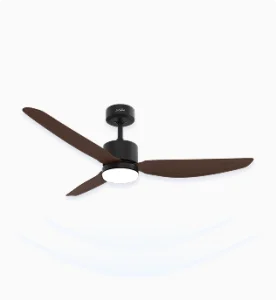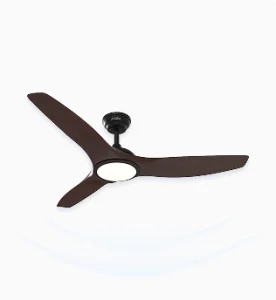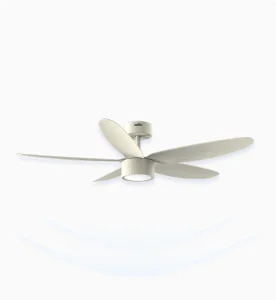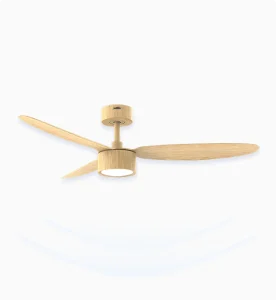





Ceiling fan CFM tells you how much air a fan moves under stated conditions. It is one of the most useful numbers on a technical sheet, yet it is easy to misuse. A large maximum value does not guarantee a comfortable bedroom, a higher speed does not automatically mean better efficiency, and a published airflow figure does not describe every corner of a furnished room. The best choice connects the number to the way the room will actually be used.
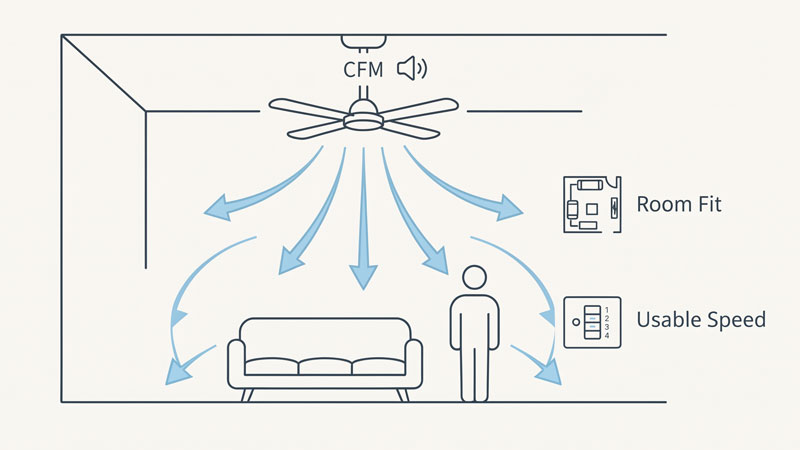
This guide explains CFM in plain language, shows how to compare airflow and power, and provides a practical process for evaluating a ceiling fan before purchase. It uses a current 1stShine model as a reference without assigning performance figures that its product page does not provide. That distinction matters: a useful specification separates verified data from assumptions and turns missing information into clear supplier questions.
Start with room dimensions, mounting conditions, occupied areas, and the speed you expect to use most often. Then compare documented performance at suitable operating points. This approach helps homeowners avoid buying excessive output they rarely use and helps project buyers compare complete configurations on equal terms. The goal is useful air movement where people need it, supported by reliable information and straightforward controls.
What CFM Means on a Ceiling Fan Specification
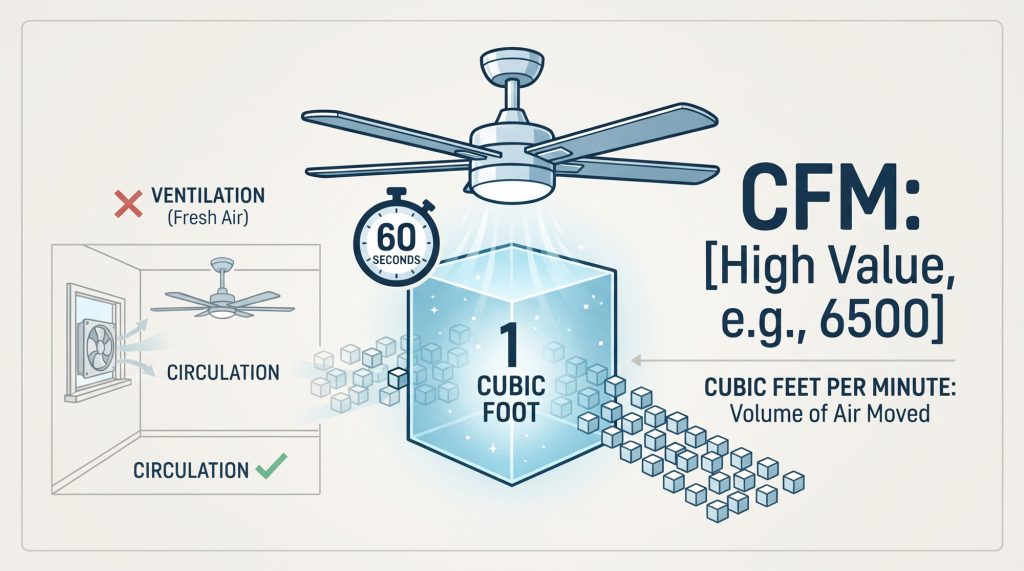
CFM stands for cubic feet per minute, a unit of volumetric airflow. For a ceiling fan, it describes an air volume moved per unit of time under the conditions of the measurement. It does not directly describe air speed at a particular chair, the temperature of the air, or the amount of fresh air entering the building. Those are different questions that require different measurements and, in some cases, different equipment.
A ceiling fan primarily circulates air already in the room. Its airflow can improve how occupants feel, but it should not be treated as an exhaust fan or a source of outdoor ventilation. If the project needs fresh-air exchange, moisture removal, or contaminant control, those requirements need their own ventilation assessment. A high CFM number on a circulating fan is not proof that the building receives the required outdoor air.
Read the number together with its conditions
Ask which speed produced the stated airflow, which blade configuration was tested, and which method was used. A maximum-speed value should be labeled as such. If a page lists an airflow number without identifying its operating condition, request clarification before using it in a comparison. The same discipline applies when a product family includes several sizes or blade sets that may not share the same measured performance.
Units also deserve attention. CFM and cubic meters per minute describe the same kind of quantity using different volume units, while cubic meters per hour uses a different time basis. Convert all shortlisted products to one unit before comparing them. Keep the original reported value and unit beside the conversion so a reviewer can trace the result and catch a misplaced factor rather than relying on an unexplained final number.
Separate a specification from a descriptive phrase
Descriptions such as powerful breeze, high performance, or rapid cooling are not substitutes for measured airflow. They may help explain how a product is positioned, but they cannot establish a numerical requirement. Ask for the supporting technical sheet when a performance claim influences the purchase. If no figure is available, keep that field open instead of borrowing a value from another product with a similar diameter or motor description.
Use the ceiling fan glossary to clarify unfamiliar terminology before requesting quotations. A shared vocabulary makes supplier replies easier to compare and reduces confusion between airflow, rotational speed, power, and lighting output. Once those quantities are separated, the technical sheet becomes more useful: each number answers a particular question instead of being treated as a general score for how good the fan must be.
Match Ceiling Fan CFM to Occupied Areas
Begin with where people will spend time. A living room might have a main seating group and a separate reading corner, while a bedroom has a bed, circulation routes, and perhaps a desk. Airflow that feels pleasant at one position may feel too strong at another. A room plan helps reveal whether the proposed fan location serves the main activity area or merely follows the center of the ceiling.
Record room length, width, ceiling height, furniture positions, and obstructions before setting a performance target. Include beams, partitions, tall storage, and decorative lighting. These features can affect placement and the experience of air movement. A single floor-area number cannot capture every layout. For an unusually shaped room, consider whether one fan can reasonably serve the occupied zones or whether a different arrangement needs evaluation.
Use a room brief before a numerical threshold
Write down the desired experience in concrete terms. For a bedroom, that may mean gentle overnight movement with unobtrusive sound. For an active family space, occupants may want a broader range of speeds. For a rental property, simple controls and repeatable operation may matter as much as maximum output. These statements guide the search for relevant performance data rather than forcing every room into the same CFM target.
The large and high CFM ceiling fan collection is a useful place to explore products when air delivery is a central requirement. It should still be treated as a starting point. Compare the actual blade span, supported mounting configuration, control range, and documented airflow for each candidate. A category name does not establish that every model will satisfy the same room brief or work equally well in every installation.
Avoid turning room volume into a circulation mandate
It is possible to divide an airflow figure by room volume and produce a theoretical circulation calculation. That arithmetic does not demonstrate uniform mixing, fresh-air delivery, or occupant comfort. A ceiling fan’s airflow pattern is not the same as an exhaust system replacing room air. Use a ventilation calculation only within an appropriate engineering framework, and do not present a circulating fan’s nominal CFM as a verified outdoor-air exchange rate.
For most buyers, a better initial process is to shortlist by room fit, obtain model-specific performance information, and evaluate the normal operating speed. Where comfort is especially important, arrange a representative sample installation. The sample should answer whether the chosen layout provides useful movement at the occupied positions, rather than merely confirming that the fan reaches its fastest setting or produces a noticeable breeze directly underneath.
Compare CFM at the Speeds You Will Actually Use
Maximum airflow is useful for understanding a fan’s upper operating range, but many installations spend most of their time below that point. A bedroom may operate gently for long periods, while a living area may use a medium setting during normal occupancy. If the purchase is based only on maximum CFM, the comparison can miss the operating condition that matters most to the people using the room.
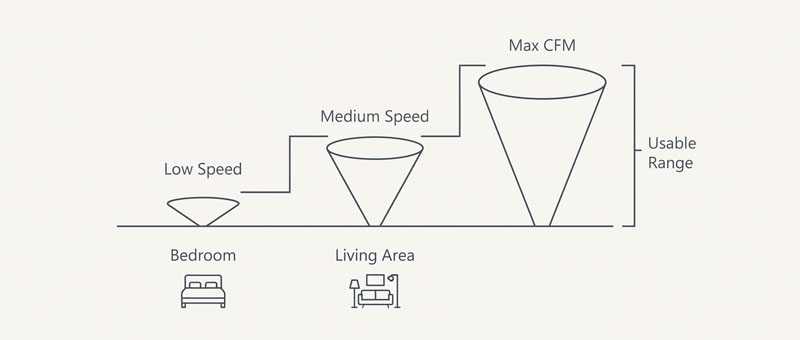
Ask for airflow and input power at several speeds where available. Also ask how the control steps are arranged. Six speed choices do not necessarily mean six equally spaced increments in airflow. The lowest setting might still feel too strong for one occupant, while the transition between two middle settings could be particularly useful in another room. Evaluate the usable range rather than counting buttons on a remote.
Build a small operating-point comparison
For each shortlisted model, record the maximum condition and the expected everyday condition separately. Keep airflow, power, and any sound information tied to their stated speed. Do not combine a low-speed power figure with a high-speed airflow figure to create an impressive but meaningless efficiency ratio. If the supplier cannot provide comparable information, mark that limitation and decide whether a sample or additional documentation is needed.
A practical comparison might show that two fans both satisfy the desired comfort level, but one has clearer low-speed control or more complete data. That can be a stronger reason to choose it than a small difference in maximum output. Conversely, a fan with an attractive low-speed setting may lack the upper range needed for a particular activity area. The room brief should determine which trade-off is acceptable.
Check what the control calls a speed
Marketing pages may describe wind modes, breeze programs, or automatic settings alongside ordinary speed steps. Ask whether a mode varies speed over time, follows a sensor, or simply selects a fixed setting. Those behaviors affect how a sample should be assessed and how performance figures should be interpreted. A changing breeze mode should not be compared casually with a steady-state measurement from another fan.
Explore the smart and modern ceiling fan range if timers, app control, or other interface features support the project. Then check the normal user routine with the exact supplied control. A sophisticated interface is valuable when it makes the preferred airflow easy to reach and maintain. It is less useful if visitors cannot understand how to select a comfortable setting without assistance or an account they do not have.
Understand CFM per Watt Without Misleading Comparisons
Airflow efficiency relates delivered airflow to electrical input. At a simple operating point, dividing CFM by watts gives a ratio expressed as CFM per watt. This can help compare products when the measurements use a consistent basis. It should not be mistaken for a complete prediction of running cost or for every certification program’s full metric, which may account for multiple operating conditions in a defined way.
The ENERGY STAR key product criteria page describes ceiling fan efficiency using a weighted metric covering multiple speeds and standby. That is a useful reminder to read definitions instead of assuming every advertised ratio has the same basis. If certification is required, request a verifiable listing for the exact model. A DC motor, an efficient-sounding description, or a product from a familiar brand does not automatically establish certification.
Work through an illustrative calculation
Suppose hypothetical Fan A delivers 4,800 CFM while drawing 40 watts at a stated operating point. The simple ratio is 120 CFM per watt. If hypothetical Fan B delivers 4,500 CFM at 30 watts, its ratio is 150 CFM per watt at that point. These invented values illustrate the calculation only; they are not specifications for any 1stShine fan and do not prove that either example meets a particular certification requirement.
The second example has a higher ratio, while the first has a higher airflow value. Which is preferable depends on the required comfort and operating pattern. A ratio should help explain a trade-off, not conceal it. Compare whether both candidates meet the room’s needs, whether the power figures include the same components, and whether the speed conditions are sufficiently comparable to support a useful conclusion.
Keep lighting and standby boundaries consistent
An integrated light can add a separate electrical load. Check whether a published fan power figure includes the light, excludes it, or describes a particular combined operating condition. Calculate lighting use according to its own hours and setting when estimating ownership cost. Otherwise, a fan with a larger light package might appear to have a less efficient motor simply because the comparison mixes different load boundaries.
Receivers and connected functions may also have standby consumption. Ask for that information where it matters to a multiroom or long-term calculation. Keep active and standby hours separate and avoid promising a saving from a single maximum rating. The energy efficient and budget ceiling fan category can help organize a shortlist, while the final financial comparison should use documented values and assumptions appropriate to the intended rooms.
Distinguish Ceiling Fan CFM From RPM and Blade Count
RPM describes revolutions per minute, the rotational speed of the blade assembly. CFM describes volumetric airflow. They are related within a particular design, but there is no universal conversion that lets a buyer calculate accurate CFM from RPM alone. Diameter, blade geometry, pitch, motor capability, and the complete assembly affect the outcome. A faster-looking fan is not automatically the better performer for the room.
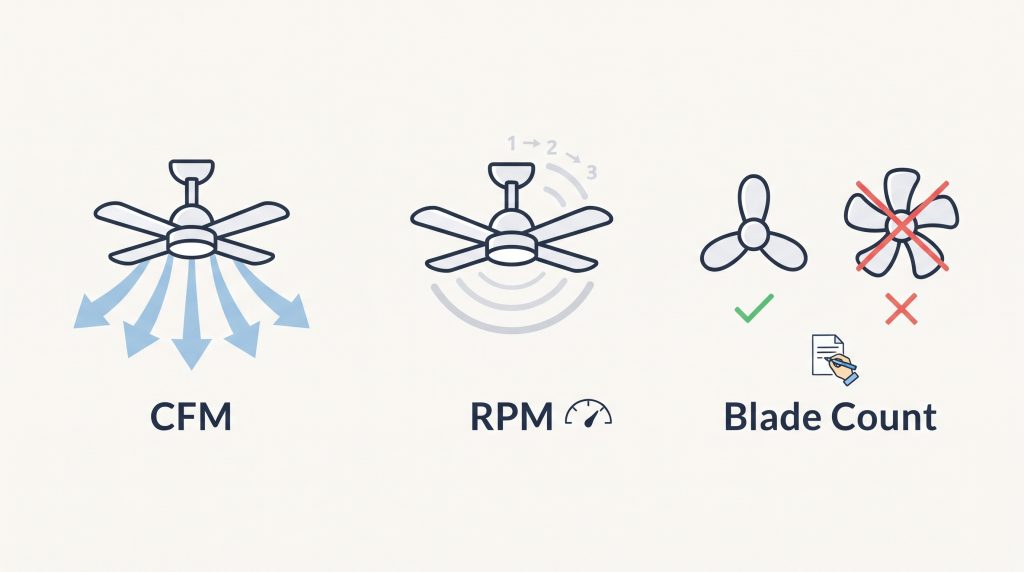
Blade count is similarly easy to overinterpret. More blades do not independently establish greater airflow, and fewer blades do not prove better efficiency. The design needs to be evaluated as a system. A decorative preference can guide the shortlist, but a numerical airflow requirement should be supported by the selected configuration’s documentation rather than inferred from appearance, motor size, or the number of blades visible in a photograph.
Read design features as questions to verify
Ask whether the reported airflow applies to the blade set and diameter in the quotation. If the manufacturer offers several blade styles, confirm whether changing them changes the tested performance or supported configuration. Treat matched components as part of the approved system. Do not substitute blades from another model or alter their geometry in an attempt to increase output without explicit manufacturer approval for that arrangement.
The ENERGY STAR performance components discussion explains that several aspects of a fan work together, including blade and motor design. Its practical value for a buyer is the system perspective. Avoid reducing the entire purchase to one dramatic specification. A fan can combine an attractive finish with a suitable motor and still be poorly matched to a room if its mounting, control range, or blade configuration has not been evaluated.
Resist unsupported upgrade claims
A supplier might offer a different motor, blade finish, or control package as an upgrade. Ask what changes in the published performance, installed dimensions, warranty, and replacement parts. An upgrade in one area can create a different requirement elsewhere. Keep the full configuration description with the quotation so later delivery checks can confirm that the measured or approved arrangement is the one actually supplied.
For decorative projects, the luxury and premium series range can provide styling options, while the airflow brief remains a separate requirement. The most useful comparison keeps appearance, performance evidence, and ownership considerations visible together. It allows a buyer to choose an acceptable compromise openly, rather than pretending that a premium finish proves high CFM or that a large airflow value automatically makes a fan visually suitable.
Check Mounting Conditions Before Judging CFM
Published airflow is measured under stated test conditions, while an installed room introduces its own geometry. Ceiling proximity, blade height, surrounding obstructions, and the supported mounting arrangement can influence practical air movement. A product’s laboratory value is useful evidence, but it is not a map showing the air speed at every point in a furnished room. Plan the installation before assuming that a rated figure alone guarantees the desired experience.
Confirm the full installed dimensions from the model drawing, including the blade plane and lowest light component. A downrod length is not the same as total installed drop. A flush-mount label does not eliminate clearance checks. Use approved accessories and have the actual support and electrical conditions assessed by a qualified installer when those conditions are uncertain. Changing an accessory is not a substitute for checking the complete arrangement.
Compare mounting styles within the actual room
The ENERGY STAR ceiling fan basics page offers general context for mounting and sizing. Use it for preliminary understanding, then follow the selected model’s instructions and applicable local requirements. A room with a low ceiling may favor a different configuration from a tall space, even if both have similar floor area. The comparison should include clearance, service access, and placement relative to the occupied zone as well as the fan’s rated output.
Review the easy installation and low maintenance collection when access or mounting complexity drives the brief. Ask which dimensions and accessories apply to the chosen variant. A product family may include configurations with different overall heights or mounting methods. The safest way to compare them is to keep a dimensioned drawing beside the performance sheet, with the selected model and option identifiers clearly marked on both documents.
Avoid treating a longer downrod as a universal improvement
A longer approved rod can change the blade position, but lowering a fan is not always the right answer. It may introduce clearance problems, affect visual proportion, or complicate service. Check the proposed position against the whole room. On a sloped ceiling, also consider the uphill blade envelope and approved adapter arrangement. One vertical dimension should not be optimized without reviewing the rest of the installation.
After the installation, investigate persistent wobble or unusual sound through the manufacturer’s process. Do not assume that a different speed setting resolves an assembly issue, and do not modify components outside the approved instructions. An airflow comparison is meaningful only when the fan is correctly assembled and installed. A mechanical problem can distort the experience and lead the owner to blame an airflow specification for an unrelated defect.
Balance CFM, Sound and Everyday Comfort
Comfort depends on more than total air volume. A high-output setting may be useful briefly and feel intrusive during a quiet activity. Sound can come from moving air, the motor, mounting vibration, or nearby objects. A statement that a fan is quiet does not describe every room or every speed. Ask for the conditions behind any acoustic figure and assess the product at the operating points that matter to the intended occupants.
A bedroom brief should consider gentle movement, intermittent sounds, control tones, and indicator lights together. A living room may place more emphasis on flexible speed selection and coverage of a seating area. Neither situation can be solved by declaring one universal CFM target. Translate the desired experience into a repeatable sample check, then use performance figures to support that evaluation rather than replace it.
Conduct a representative sample review
Choose a sample matching the intended size, blade set, control package, and mounting style. Listen and assess air movement from normal occupied positions, not only from directly beneath the motor. Record the speed used and any background conditions that could affect the judgment. A showroom demonstration can prove that a feature exists, but it cannot reproduce every room layout or establish that the final installation will feel identical.
The bedroom and quiet ceiling fan range is a useful starting point for rest spaces. Compare candidates against a short set of observations: whether the lowest practical speed is comfortable, whether control changes are clear, and whether any sound is disruptive for the intended use. Specific observations are more actionable than a general verdict that one motor technology is quiet or another blade count must be noisy.
Include control recovery in the comfort assessment
Ask what happens after a power interruption and how the fan returns to the preferred setting. Does it remain off, restart, or restore a stored state? The answer is model-specific and can affect a bedroom or managed property significantly. Confirm the supplied instructions and test appropriate behavior during commissioning. A fan that is comfortable in steady operation may still frustrate users if everyday recovery is confusing.
For a multiroom project, document one normal control routine and a clear support route. Keep replacement remote details and pairing instructions available to the maintenance team. If connected functions are included, identify who manages accounts and what remains usable without the network. These practical details do not change the published CFM, but they strongly influence whether occupants can reliably obtain the airflow that justified the purchase.
Evaluate a Real Fan Without Inventing a CFM Rating
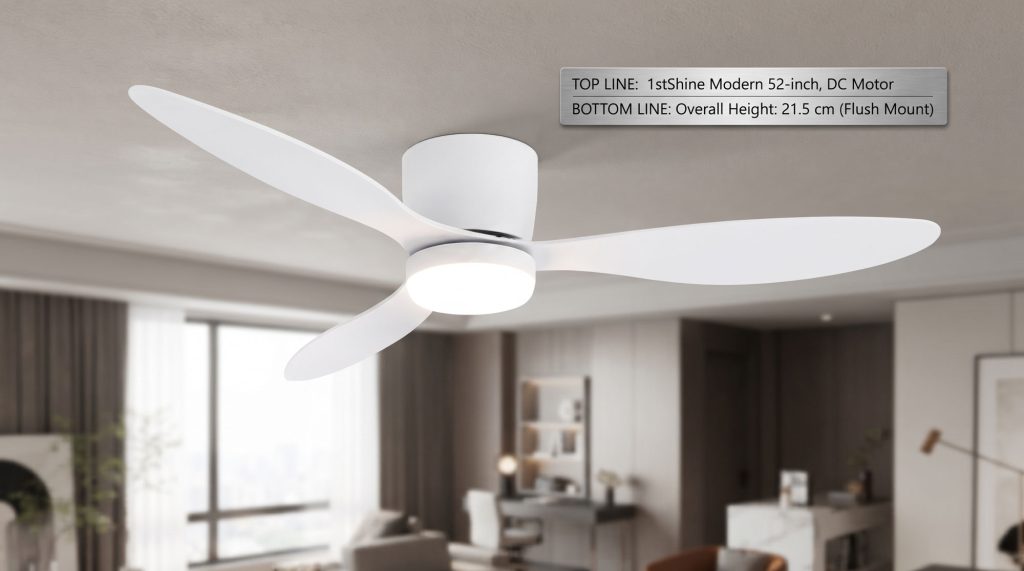
The reference model is the 1stShine Modern 52-inch 6 Speed Ceiling Fan Timer Function. Its current product information describes a DC motor, six speed choices, a timer, reversible operation, and an integrated LED. The displayed 52-inch configuration lists a 132 cm diameter, a 21.5 cm overall height, and flush mounting. A separate 42-inch option also appears, so a quotation should identify the exact selected size.
These features make the model a useful candidate for an indoor application that values multiple speed choices and a compact mounting profile. They do not, by themselves, establish an airflow rating. This guide does not assign a CFM value, measured sound level, or quantified energy saving to the product. Request configuration-specific test information before making a numerical performance commitment or comparing it with a fan whose documentation includes measured airflow.
Turn the feature list into an evidence request
Ask for maximum airflow, airflow at the normal use speeds, input power at the same points, and the applicable test method. Confirm whether the values refer to the 52-inch configuration and the supplied blades. For the timer, ask which durations are available and what functions it controls. For reversible operation, ask how it is selected and what sequence the instructions require. These questions connect features to behavior that can be checked.
For the light, request the output and electrical information relevant to the proposed room, keeping that load separate from the motor comparison. For mounting, obtain the full drawing rather than inferring blade height from the overall height alone. For environmental suitability, confirm the exact model’s documentation. An indoor product description should not be expanded into an outdoor rating merely because another model in the same brand is shown on a patio.
Record the gaps instead of filling them with assumptions
A supplier brief can remain concise: state the room dimensions, installation location, preferred operating pattern, lighting needs, and the performance information required for approval. Label missing airflow or power information as pending. That is more useful than copying a plausible number from another product, because it preserves a clear path for obtaining the correct data and prevents an unsupported figure from spreading into purchase orders or customer promises.
For an outdoor project, use the all-weather outdoor ceiling fan category to identify more appropriate candidates and then check documented ratings. Indoor and outdoor needs should not be mixed in one comparison without acknowledging the difference. A fan may suit the airflow brief but fail the environmental brief, or vice versa. The final shortlist should satisfy the required conditions together rather than scoring well on one headline specification.
Use a CFM Comparison Table and Acceptance Checklist
A comparison sheet should show what is known, how it was measured, and which questions remain open. Place the exact model and configuration at the top of each column. Keep speed-specific airflow, power, and acoustic information together so they cannot be accidentally combined across conditions. A transparent table makes an incomplete quotation visible without forcing the buyer to reject a candidate before the supplier has a chance to provide the missing evidence.
| Comparison item | Information to request | Reason it matters |
| זרימת אוויר | CFM at stated speed and test method | Makes output comparisons traceable |
| Electrical input | Watts at the same operating condition | Supports an honest efficiency calculation |
| Normal use | Low and medium speed behavior | Reflects everyday comfort rather than maximum output alone |
| Room fit | Blade span, installed dimensions and approved mounting | Connects the product to the actual space |
| Controls | Included devices, recovery behavior and compatibility | Ensures occupants can reach the intended setting |
| Documentation | Exact model identifier, variant and support route | Keeps approval, delivery and maintenance aligned |
Define acceptance before the sample arrives
Decide what the sample needs to demonstrate and who will assess it. A useful brief names occupied positions, typical speeds, acceptable control behavior, and issues that require follow-up. Do not demand that a casual room demonstration reproduce a standardized laboratory test. If a contractual airflow threshold matters, specify appropriate documentary evidence or a properly planned test rather than treating a handheld impression as equivalent to a certified measurement.
- Confirm that the delivered model, size, blades and control package match the approved specification.
- Keep each airflow and power value tied to its operating condition and source.
- Check normal operation from the locations where occupants will actually use the room.
- Record installation issues separately from performance questions and arrange appropriate follow-up.
- Retain instructions, warranty terms and replacement-parts information with the room record.
Use clear records for larger orders
In a repeated installation, identify rooms and configurations consistently. Similar-looking fans may have different size or control options, and a later substitution can change the comparison. Record any approved change and review its effect on airflow evidence, installed dimensions, and service parts. A room schedule helps installers place the correct package and gives the owner a reliable reference when a replacement is needed months or years later.
The commercial comparison should also include installed cost, accessory requirements, warranty scope, and service access. A fan with a lower purchase price can require additional controls or more difficult access, while a higher-priced model may offer features the room does not need. Keep these trade-offs explicit. CFM is valuable information, but its purpose is to improve a purchase decision rather than dominate every other requirement in the brief.
Conclusion: Choose CFM for Useful Room Performance
Ceiling fan CFM is most useful when it is attached to a documented configuration, a stated operating condition, and a real room brief. Compare normal-use airflow as well as maximum output, keep power measurements on the same basis, and distinguish circulation from outdoor ventilation. A good specification makes uncertainty visible and gives the supplier a clear way to resolve it before the buyer makes commitments that the available evidence cannot support.
The reference 52-inch six-speed fan illustrates the difference between a promising feature set and a verified airflow specification. Its published motor, speed, timer, light, and mounting information can support a shortlist, while a numerical CFM claim still requires the appropriate technical evidence. The next step is a configuration-specific inquiry and, where useful, a representative sample review that checks comfort, controls, fit, and installation together.
Contact the 1stShine team with room dimensions, ceiling height, occupied areas, intended operating hours, and the model you are considering. Request airflow and power information at the speeds relevant to your project, together with the mounting drawing and control package details. That practical brief makes it easier to compare options honestly and choose a ceiling fan for the useful air movement and ownership experience it can deliver.