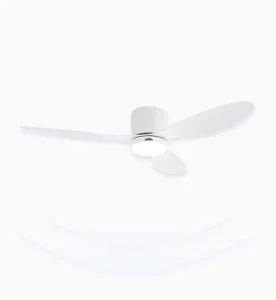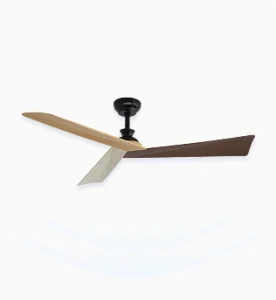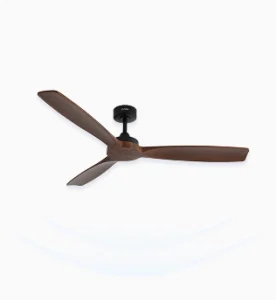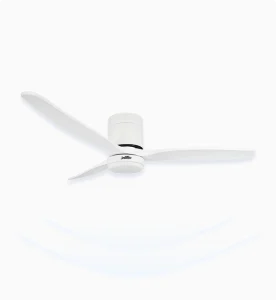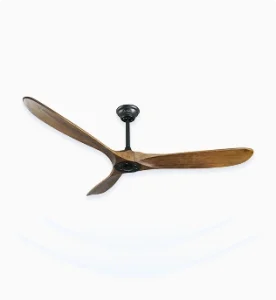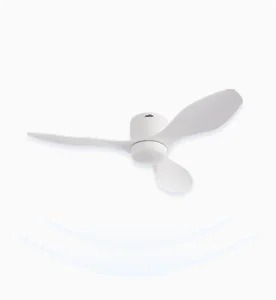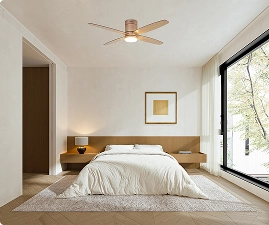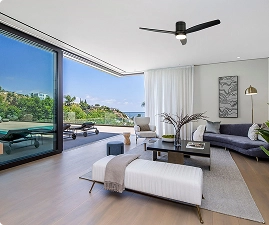





Ceiling fan blade pitch is the angle of a blade relative to its plane of rotation. It helps explain how a rotating blade moves air, but it is not a complete measure of fan performance. A larger angle can increase the aerodynamic demand on the motor, and the result depends on blade shape, diameter, speed and the rest of the assembly. Choosing a fan by its advertised pitch alone can therefore lead to a disappointing comparison.
This guide is for homeowners, designers and project buyers who want to understand the technical meaning of blade pitch before selecting a ceiling fan. It explains the basic mechanism, the limits of simple angle comparisons and the documents worth requesting. A current six-speed indoor model from 1stShine provides a practical reference, with a clear distinction between published features and performance information that still requires confirmation for the selected version.
What Ceiling Fan Blade Pitch Means
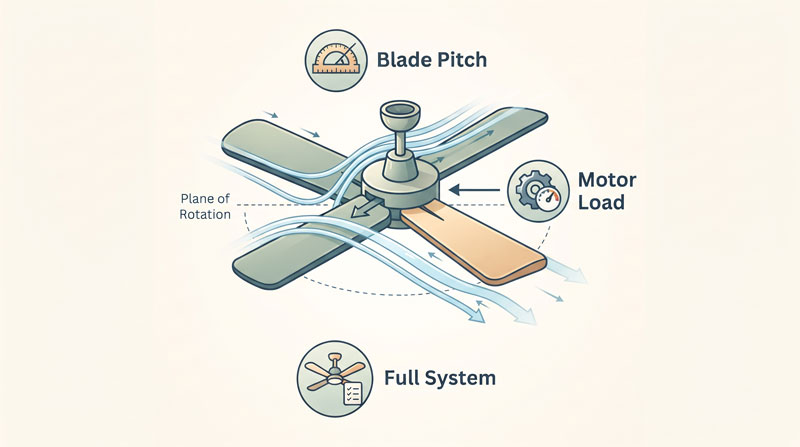
Blade pitch describes the inclination of a blade section against a reference plane. For a ceiling fan, that reference is commonly the plane in which the blades rotate. Imagine a flat blade moving around the ceiling with its broad surface parallel to that plane. Tilting the blade changes how its surface meets the surrounding air. The angle is usually expressed in degrees, but its meaning depends on where and how it is measured.
A single pitch number is a simplified description
Some blades have a relatively simple shape and a fairly consistent inclination. Others curve or twist from root to tip, so different sections have different local angles. A catalog might publish one nominal figure without showing the measurement station. That number can be useful within a product family, but it may not describe the full geometry of a sculpted blade.
Ask the manufacturer what the stated angle represents when pitch is important to the project. Is it measured at a defined radius, estimated from the blade holder or used as a nominal design description? A dimensional drawing or technical explanation helps establish whether two numbers are comparable. Without that context, a precise-looking degree value can hide differences in the measurement itself.
Pitch is not the same as blade count or curvature
Blade count tells you how many rotating elements the assembly contains. Curvature describes the shape of an individual surface. Pitch describes an angular relationship. Those characteristics interact, but they are not interchangeable. A curved blade can have different local pitch along its span, and two fans with the same number of blades can have very different aerodynamic behavior.
Use the ceiling fan glossary to keep related terms separate while reading specifications. Write down diameter, rotational speed, airflow, input power and pitch in separate fields. That simple practice prevents a familiar category error: treating a geometric description as if it were a measured air delivery result. The buyer needs both useful design information and evidence of the assembled product’s performance.
How Blade Pitch Helps a Ceiling Fan Move Air
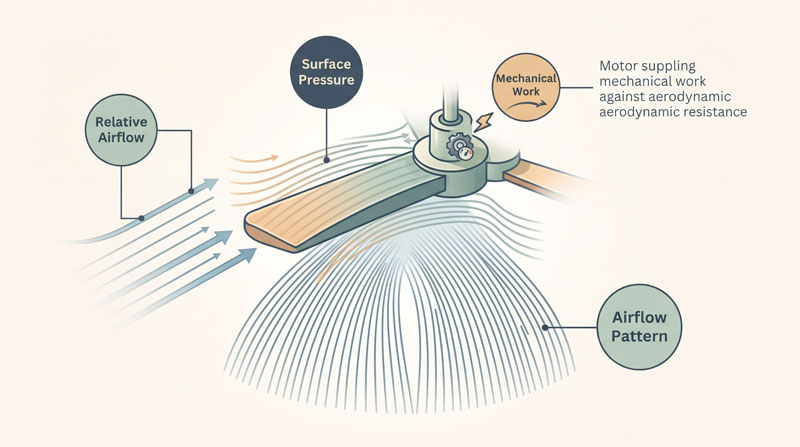
As a blade rotates, it encounters air with a relative direction and velocity. Its orientation and shape influence the pressure distribution around its surfaces and the forces applied to the air. The combined action of the rotating blades creates an airflow pattern through and around the fan. The motor supplies the mechanical work needed to maintain that motion against aerodynamic resistance and other losses.
Geometric pitch differs from the operating angle of attack
The angle of attack is the angle between a blade section’s reference direction and the relative airflow approaching that section. Geometric pitch is referenced to the rotational plane. They are related, but they are not necessarily equal, because the air near an operating fan is already moving. Changes in rotational speed, induced flow and position along the blade can change the local aerodynamic conditions.
This distinction matters when someone claims that one pitch angle guarantees a particular airflow. The geometry establishes part of the operating situation, while the actual flow and motor speed help determine what happens in use. A drawing can show a blade angle; it cannot by itself demonstrate the final CFM or the air velocity at a person’s chair. Those are outcomes to measure on the complete fan.
Why the blade tip behaves differently from the root
At a common rotational speed, a point near the blade tip travels farther during each revolution than a point close to the hub. Its tangential speed is therefore greater. Designers may vary the geometry along the span to suit those different local conditions. That is one reason a single nominal pitch value can be an incomplete description of a modern molded blade.
Increasing pitch also changes the load
If other conditions remain similar, increasing a blade’s inclination can increase the aerodynamic loading. However, a motor may not hold exactly the same speed under a different load, and the flow may not improve proportionally. Excessive incidence can also produce inefficient flow separation in some operating conditions. The practical outcome depends on the design rather than following a universal more-angle-equals-more-air rule.
A household buyer does not need to calculate these interactions from scratch. The useful consequence is to request tested airflow and power for the actual assembly. The engineering explanation tells you why the question matters; the product data tells you whether a particular design meets your requirements. Keep those two forms of evidence connected rather than substituting an attractive theory for a measurement.
Why Higher Blade Pitch Is Not Always Better
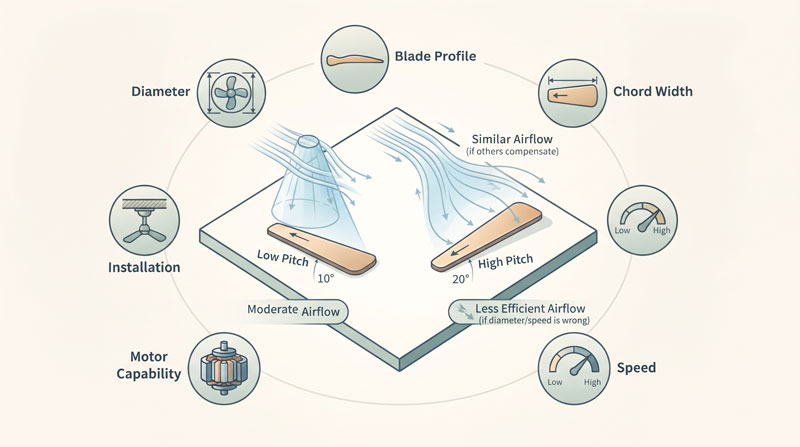
Two ceiling fans can have different pitch angles and still deliver similar airflow, or share a nominal angle while producing different results. Diameter, blade profile, chord width, speed, motor capability and installation conditions all contribute. Pitch is one design variable within that system. A purchasing rule based only on the largest advertised angle ignores most of the variables that determine useful air movement.
Compare complete assemblies under comparable conditions
ENERGY STAR performance components guidance identifies motor and blade characteristics as contributors to fan performance and specifically cautions that higher pitch is not always better. The practical lesson is to compare the complete fan. Look for airflow, electrical input and operating settings reported for the same configuration, rather than choosing the steepest blade in a group of unrelated designs.
Consider a hypothetical comparison between Fan A and Fan B. Fan A has a higher nominal pitch, while Fan B has a larger span and a different motor operating point. The angle alone cannot tell you which moves more air or uses less electricity. Even when one fan delivers higher maximum airflow, you still need to know whether its lower settings suit the room and whether the installation is appropriate.
Distinguish maximum airflow from useful comfort
A high-speed measurement describes one operating point. It may help identify available capacity, but it does not automatically describe a comfortable evening setting. Some rooms benefit from a broad, moderate breeze, while others require finer low-speed control. An assembly that performs well at the settings people actually use may be preferable to one selected primarily for an impressive maximum number.
For a large room, investigate the large and high CFM ceiling fan category and request documented air delivery for the shortlisted models. For a smaller occupied area, pay attention to distribution and controllability. Neither decision can be settled by pitch alone. The right comparison connects the fan’s supported operating range to the people and places that need the airflow.
Avoid a universal ideal angle
An advertised range of angles can be useful background information, but it should not become a universal acceptance criterion without engineering justification. Different blade profiles and product sizes can use different geometries effectively. A supplier should be able to explain a design and provide relevant performance information, rather than relying on an unsupported claim that one degree value is optimal for every ceiling fan.
If a project specification already demands a particular pitch, ask why that requirement exists. It may reflect a previous product rather than the functional need. A performance-based requirement, supported by the intended application and suitable test data, often makes the decision clearer. Do not remove a contractual requirement casually; clarify its purpose before treating a different design as equivalent.
Reading Blade Pitch Alongside Other Specifications
A useful comparison sheet separates geometry, operating performance and installation compatibility. Each answers a different question. Geometry describes the assembly, operating data describes what it does, and installation information establishes where and how it can be used. Combining those categories gives a more complete view than highlighting one feature while leaving the rest of the specification undefined.
Build an evidence checklist
The following table is a purchasing framework, not a set of test results for the featured product. Use it to identify which information is published, which needs a technical sheet and which should be evaluated through a sample. Keep missing values blank or explicitly marked as unavailable. Copying a number from a similar-looking product can make the comparison less reliable than leaving the uncertainty visible.
| Item | What it describes | Evidence to request |
| Blade pitch | Nominal or local blade inclination | Measurement definition and drawing if relevant |
| Blade diameter | Overall swept span | Dimension for the selected size |
| Blade profile | Shape and variation along the span | Model-specific design description |
| Rotational speed | Revolutions at an operating setting | Per-setting RPM table if available |
| Flujo de aire | Volume of air delivered | Test result and stated conditions |
| Electrical input | Power used at an operating point | Watts with light load identified separately |
| Controls | Available adjustments and commands | Approved controller instructions |
| Instalación | Mounting and required clearances | Current installation manual |
The same model reference should appear on the documents supporting the comparison. A family page may cover several diameters, finishes or electrical market versions. Do not assume that a result for one variant applies unchanged to another. Record the selected configuration on the quotation and purchase order so that performance claims, drawings and delivered units refer to the same product.
Keep airflow units and measurement conditions visible
Airflow might be expressed in cubic feet per minute or cubic metres per minute. Those units can be converted mathematically, but conversion does not resolve different test methods or operating settings. Identify the original unit, test conditions and fan configuration before making a numerical comparison. A high-speed figure on one product should not be compared with a weighted or undefined figure on another as if they describe the same result.
Likewise, distinguish motor input from total fixture input when integrated lighting is present. A fan operating with its light on uses a different total load from the motor alone. If electricity cost is part of the decision, request data that matches the intended routine. Blade pitch does not provide the missing wattage information, and a motor type label does not supply a complete energy calculation.
Blade Pitch in a Current Six-Speed Product Example
The current product page for the Modern 52-inch 6 Speed Ceiling Fan Timer Function lists a DC motor, selectable speeds, a timer and reversible rotation. Its 52-inch specification shows a 132 cm diameter, flush mounting and integrated LED lighting. These details establish a useful starting point for an indoor shortlist. They do not reveal a complete aerodynamic design or a measured performance curve.
Use published features without inventing missing angles
The product reference is DCF-K52070L. A complete blade-pitch drawing and per-speed table of RPM, airflow and electrical input are not established by the feature listing. A buyer requiring those details should request the documents for the selected version. Do not assign a nominal pitch from a photograph or describe an angle as measured when it has not been supplied.
The same caution applies to sound and efficiency claims. A description of quiet operation is not a documented acoustic result under stated conditions. Six selectable speeds describe control options, not six published RPM values. Treat the page as a source of the listed configuration and functions, then ask for the evidence needed to approve any numerical performance requirement.
Match the category to the actual application
The smart and modern ceiling fan collection is relevant when contemporary styling and convenient operation are priorities. Category names do not establish that every item supports Wi-Fi, an app, voice commands or a specific automation platform. Confirm those functions for the exact product when they matter. An article about blade pitch should not add unrelated connectivity promises simply because the fan appears in a modern product range.
The ceiling fans with lights collection can help with a combined fan and lighting plan, but light output and fan aerodynamics need separate checks. Confirm lighting features, control compatibility and service arrangements independently of blade geometry. A suitable blade design cannot compensate for an unsuitable light specification, and an attractive integrated light does not prove comfortable airflow at every speed.
Create a focused request for technical information
For this example, a useful request identifies the model, selected diameter and market version, then asks whether a nominal blade-pitch definition and per-setting performance data are available. Add the room dimensions and installation constraints. That gives the supplier a concrete question to answer and avoids a vague exchange about whether a particular angle is generally good.
Blade Pitch, Speed and Electrical Efficiency
Blade pitch influences the aerodynamic load, while the motor and control system establish how the fan operates against that load. The electrical input includes losses as well as useful mechanical output. As a result, pitch cannot be used on its own to calculate watts or efficiency. A steeper blade is not automatically more economical, and a shallower blade is not automatically less effective.
Evaluate the airflow delivered per unit of input
When comparing efficiency, ask which airflow and power figures belong to the same operating point. Dividing a maximum airflow value by a wattage reported at a different speed produces a misleading result. The comparison should also identify whether lighting or standby consumption is included. Clear reporting matters more than carrying extra decimal places on an inconsistent calculation.
The energy efficient and budget ceiling fan range provides a place to investigate products with operating-cost priorities, but its category label does not replace model-specific evidence. Compare the documented configuration, useful airflow and control options together. A fan that must run at an uncomfortable setting to deliver its best advertised ratio may not be the most useful choice for the intended room.
Use transparent operating-cost scenarios
For an electricity estimate, multiply input watts by operating hours and divide by one thousand to obtain kilowatt-hours. Multiply that energy by the applicable tariff. State the assumed wattage, hours and price so the result can be updated when the final technical data is available. This calculation uses electrical input, not blade pitch, as its starting point.
For example, a hypothetical 30-watt motor running six hours would use 0.18 kWh. At an illustrative tariff of 0.20 per kWh, the cost would be 0.036 in the same currency for that period. These are arithmetic examples, not specifications for the featured model. Add lighting and other relevant consumption separately rather than presenting the example as a complete household saving forecast.
Recognize the limits of changing one variable
Engineering estimates sometimes examine how a similar fan behaves when speed changes, but changing blade pitch can alter the aerodynamic characteristics themselves. A simple speed-scaling relationship should not be used to predict a modified domestic fan’s performance without appropriate justification. The same principle applies when substituting another blade shape or span: the original test result no longer automatically represents the new assembly.
For procurement, the practical response is to keep the tested combination intact. Request documented options from the manufacturer when a project needs a different appearance or operating range. A controlled factory variant with supporting data is easier to evaluate than a field modification whose motor loading, balance and long-term behavior have not been established.
Blade Pitch and Comfortable Air Distribution
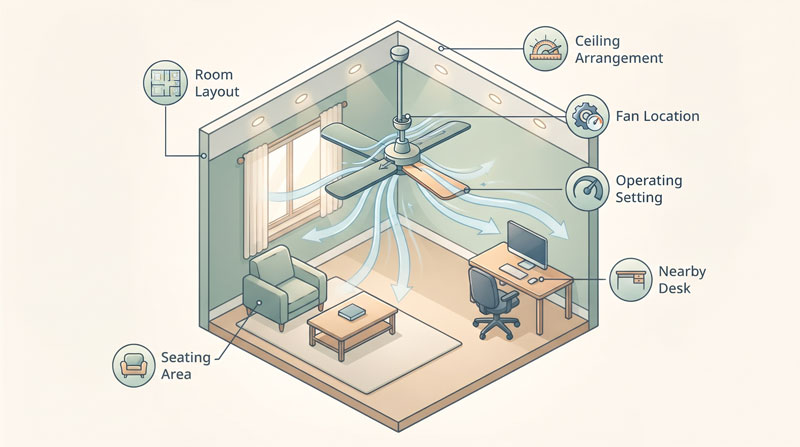
Comfort depends on where the air reaches people, not just how the blade is inclined. The room layout, ceiling arrangement, fan location and operating setting influence the experience. A technically interesting pitch value cannot show whether the breeze will reach the seating area evenly or become intrusive at a nearby desk. Evaluate the complete installation in the context of the occupied space.
Start with activity and position
For a bedroom, consider the bed location and whether a gentle setting remains comfortable after the occupant settles to sleep. For a living area, assess the main seats rather than judging only directly under the hub. Moving from one position to another may change the sensation noticeably. If distribution is poor, increasing speed can strengthen the breeze in one place without resolving the underlying layout issue.
The bedroom and quiet ceiling fan range is relevant when low-setting comfort and sound are priorities. Ask for useful information about the selected model and, where practical, assess a sample. Record the location, setting and conditions of the evaluation. A subjective observation can help choose a product, provided it is not relabeled as a universal pitch recommendation or a certified measurement.
Separate circulation from room temperature reduction
A ceiling fan produces air movement that can improve an occupant’s comfort. It does not function like a refrigeration system that actively removes heat from the room. ENERGY STAR installation and usage advice recommends turning a ceiling fan off when the room is unoccupied. This reinforces the value of selecting a breeze people find useful rather than running a fan solely because its geometry sounds efficient.
When a timer is available, confirm the supported intervals and what happens to the fan and light at shutdown. A timer can support an occupancy routine, but it does not change the blade pitch or establish the quality of the airflow. Match the routine to the user’s needs and verify any specific control behavior before including it in a project promise.
Understand what reverse rotation changes
Reversing rotation changes the direction in which the assembly moves and can alter its circulation pattern. It does not physically adjust a fixed blade’s pitch. Follow the manufacturer’s instructions for selecting direction and speed, including any requirement to stop the fan before changing modes. Evaluate the resulting circulation rather than assuming that a reverse button creates an identical airflow magnitude in the opposite direction.
For seasonal use, the useful objective may be gentle mixing rather than a strong direct draft. The correct routine depends on the room and the fan’s instructions. Avoid a universal performance claim based on rotation direction alone. Both blade geometry and the operating condition contribute to the result, and the user should be able to choose a comfortable setting.
Installation Conditions That Limit Blade Pitch Comparisons
The available space around a fan affects how it can be installed and used. Required clearances, mounting type, structural support and environmental approval must be addressed before a design is selected. A fan with appealing aerodynamic specifications can still be unsuitable for a particular ceiling. Slowing it down or choosing a different pitch does not remove a physical installation requirement.
Confirm dimensions that relate to the blade plane
Overall fixture height is not necessarily the same as the distance from the ceiling to the blades. Integrated lights and housings can extend below the rotating assembly. If a clearance decision depends on blade position, request the relevant dimension or drawing. Do not estimate a missing measurement from a perspective photograph or subtract unrelated catalog dimensions without confirming the geometry.
A flush-mount product describes a mounting arrangement, not automatic suitability for every low ceiling. A sloped ceiling may require a different approved installation. Identify beams, cabinets, doors and other nearby obstructions and compare the layout with the manufacturer’s current manual. Where local requirements apply, have a qualified installer evaluate them for the actual location.
Use suitable support and approved components
The easy installation and low maintenance ceiling fan collection can help identify ownership features, but each fan still needs its specified support and mounting hardware. A fixture box intended for a light should not be assumed adequate for a rotating fan. Have the installer verify the applicable fan-rated support arrangement and follow the product instructions rather than adapting unrelated hardware to make the fan fit.
Control compatibility matters as well. ENERGY STAR control compatibility guidance warns against operating a fan motor with a conventional lighting dimmer. Use the approved control system for the selected assembly. An electrical control that produces a lower speed does not become a safe or supported way to compensate for an unsuitable blade design or installation.
Do not infer outdoor approval from blade material
ABS, metal or wood describes a material choice, not the environmental approval of the complete fan. Motor protection, electronics, fasteners, finishes and assembly details all matter. A sheltered porch can expose a product to moisture or other conditions absent indoors. Neither a steep blade angle nor a corrosion-resistant-looking finish establishes that an indoor fan is suitable for that setting.
For exterior projects, investigate the all-weather outdoor ceiling fan collection and request the exact location rating and installation instructions. Keep the product’s approved environment separate from its aerodynamic description. That distinction prevents a material or pitch discussion from becoming an unsupported claim about the durability of the entire fixture.
Blade Pitch, Maintenance and Replacement Decisions
Most household ceiling fans have fixed blade geometry intended to remain as supplied. Owners should not treat the blade angle as a routine adjustment for improving airflow. Bending holders, trimming blades or adding improvised parts can change balance and loading. If performance seems inadequate, first check the selected model, control setting, room layout and installation with the manufacturer’s support process.
Preserve the matched blade assembly
Replacement blades should be approved for the exact fan and supplied in the required matching arrangement. A blade that fits the screw pattern is not automatically equivalent in mass, shape, pitch or aerodynamic load. Even an apparently small difference can affect the rotating assembly. Obtain the correct parts and installation instructions rather than choosing by appearance alone.
If a blade is damaged, stop using the fan and seek model-specific advice. Running at a lower speed does not repair a crack or restore the intended structural condition. Keep the model reference and purchase documentation available so support can identify the relevant components. Where replacement requires work beyond routine owner maintenance, use an appropriately qualified service provider.
Clean without altering geometry
Follow the manufacturer’s cleaning procedure and isolate power as instructed before working near the blades. Support the task safely and avoid pressing hard on blade edges or holders. Removing accumulated dust is different from changing the geometry. Do not use abrasive treatment, solvents or added coatings unless the manufacturer approves them for the surface and component.
After cleaning, observe normal operation from a safe position. If there is new wobble, scraping or a repeated click, stop and investigate through the approved support process. The useful record includes the setting, when the symptom appeared and whether any maintenance or replacement preceded it. Those details are more actionable than guessing that the fan needs a steeper pitch.
Distinguish a new symptom from an original selection issue
A fan that has always provided insufficient circulation may require a review of selection or placement. A fan that suddenly changes behavior may have a control, mounting or component issue. Treating both situations as an angle problem can delay the correct response. Record the timeline and avoid modifications until the manufacturer or installer has identified the likely cause.
A Practical Blade Pitch Buying Checklist
Use blade pitch as a prompt for better questions rather than as a shortcut to a ranking. The purchasing decision should identify the room requirement, the exact product and the evidence supporting its performance. That approach works for a single bedroom as well as a project with several repeated rooms. It also makes it easier to explain why a shortlisted fan fits the application.
Turn a feature list into an approval process
Begin with the physical constraints and intended use. Then collect model-specific dimensions, control instructions and relevant performance results. Where information is unavailable, decide whether a sample or another product is needed. Keep the distinction between missing evidence and a confirmed limitation clear; a product page that omits an angle has not necessarily demonstrated either poor or excellent aerodynamic design.
- Define the occupied areas and the type of breeze they need.
- Confirm diameter, mounting arrangement and required clearances.
- Ask what any published pitch figure represents and where it is measured.
- Compare airflow, input power and settings for the same configuration.
- Check approved controls, lighting requirements and maintenance access.
- Keep unsupported numerical claims out of the final purchase specification.
When reviewing the broader ceiling fan product collection, apply the same evidence standard to each shortlisted item. A clearly documented lower nominal angle can be easier to evaluate than a higher angle accompanied only by vague claims. The goal is not to reward the longest specification sheet; it is to connect the important requirements to reliable, relevant answers.
Record a sample evaluation accurately
For a sample, note the model, size, controller, room context and settings used. Record subjective comfort separately from measured performance and formal approvals. If several people will use the space, collect their feedback rather than treating one preference as universal. A useful sample record tells a later buyer what was actually evaluated without suggesting that an informal demonstration replaced a laboratory test.
For repeated deliveries, retain the approved configuration and ask how substitutions will be handled. A different blade or receiver can affect more than appearance. The supplier should identify the change and provide the relevant documentation before it is accepted. That keeps the original decision traceable and prevents a nominal pitch figure from disguising an otherwise different assembly.
Conclusion: Choose Blade Pitch as Part of the System
Ceiling fan blade pitch helps explain how the blades interact with air, but it cannot establish airflow, efficiency or comfort on its own. The complete design, operating speed and installation conditions determine the useful result. Compare documented performance at the settings you expect to use and keep geometry, measurements and subjective impressions clearly identified.
The featured six-speed indoor model provides a concrete starting point for a technical discussion, while its unpublished pitch and performance details remain questions for the selected configuration. That is a practical boundary for responsible product selection: use the verified features to build a shortlist, then obtain the information needed to approve the intended application.
Contact the 1stShine team with your room dimensions, ceiling details, selected size and everyday airflow priorities. Request the matching technical sheet, installation manual and approved control information. A clear brief makes it easier to choose a complete ceiling fan that fits the room and delivers useful comfort, with blade pitch understood in its proper context.